



From students once parading with torches to today’s highly decorative floats, the SMU Homecoming parade has evolved since its beginning.
The first Homecoming parade took place a day before Thanksgiving in 1926. Students and alumni marched across campus carrying 2,000 torches. There was also a parade the next morning made up of students’ cars, according to SMU’s Homecoming Memories website: “The biggest parade ever had by a group of Mustang supporters will begin promptly at 11:30 Thursday morning. Bring your car, if you have one, decorated with a sign designating your class.”
The only parade to be canceled was in 1942, due to the shortage of transportation during World War II.
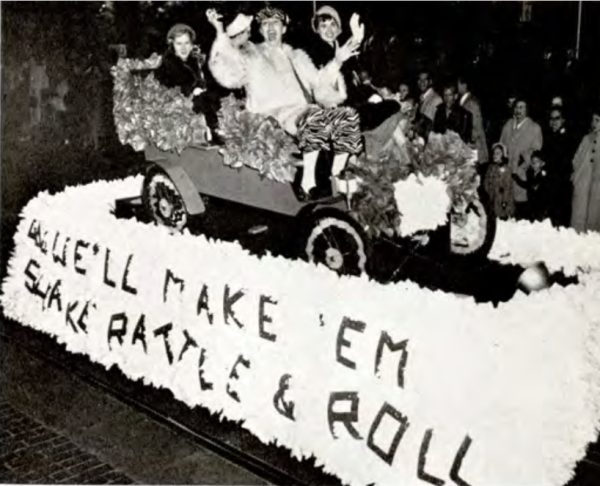
A major milestone came on the 50th anniversary of Homecoming when all Homecoming Queen nominees rode onto the field on a float, disguised to look like a cake celebrating SMU’s 50th anniversary.
The floats are a central part of Homecoming to welcome alumni back to campus to relive their traditions. Chuck Massoud, class of 1985, recalled many memories with his brothers of Beta Theta Pi before and during the Homecoming parade. The parade has been a way for student organizations and Greek life to showcase their hard work to alumni and the rest of campus.
“It would take one to two weeks to prepare and build the floats,” Massoud said. “I couldn’t imagine what the floats are looking like now because ours were pretty ragged.”
In 1992, SMU President Kenneth Pye, along with the Student Foundation, donated $2,000 to fund parade floats for organizations that couldn’t afford to have one. Not long after, each student organization was given $1,000 to help build a float, and the number of parade entries grew to 13 floats. Since 2002, the parade has shifted from always being held on Friday nights to Saturday mornings.
Building the parade floats now is no laughing matter, according to SMU senior Chloe Almond. She served as Alpha Chi Omega’s vice president of membership programming in 2024, and was responsible for overseeing all her sorority’s parade float design and execution. Pomping, which is the rolling of tissue paper into tiny balls and gluing each one on a float, is the main part of decorating the floats. It’s also the most tiring task, Almond said, adding each float had close to 20,000 pieces of tissue paper.
“Out of the 54 pomping hours, I was there for 52,” she said. “I remember everyone giving a big group hug at the end and a sigh of relief.”
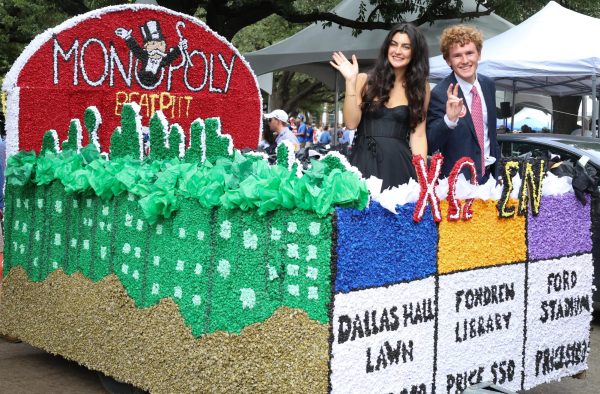
Decorating the float early was a big landmark for all the members involved in Homecoming, but the process of setting up the parade starts months in advance. Parade coordinator Ava Stallard has worked every day over the summer. She’s wanted to be part of Homecoming since she was little.
“I love how everyone gets involved,” Stallard said. “I loved getting to see all the nominees looking like princesses, and it made me want to be the one who helps put on such a great event.”
Being the parade coordinator is not as easy as it sounds. Stallard has been on Zoom calls with members of the Highland Park community, trying to get more people aware and involved. She’s also been on calls with SMU organizations to make sure everything runs smoothly.
“It’s going to be all hands on deck,” Stallard said.
SMU has celebrated Homecoming for almost 100 years. The parade remains more than just a procession of floats and fanfare. It’s a living symbol of Mustang pride, perseverance, and the ties that bind generations of SMU students and alumni. From torch-lit marches in the 1920s to today’s vibrant float showcases, this tradition continues to evolve with the times while staying rooted in the same spirit of community and celebration.