



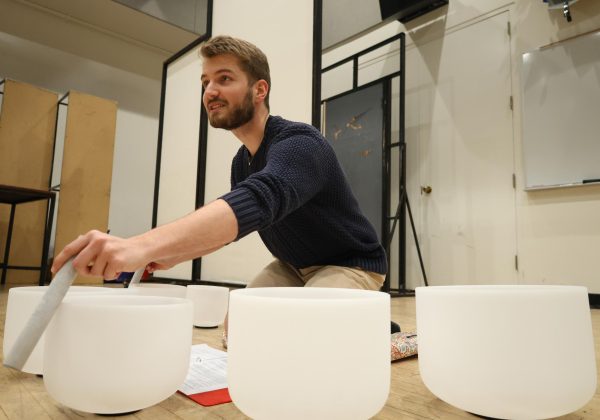
William Schmitt is sitting on a pillow surrounded by partially opaque bowls descending from small to large. He whispers to himself, then picks up a wide wooden stick with felt on the end. He gently swirls the stick around the largest bowl as the room fills up with an all-encompassing hum, only to be interrupted by a shocking yet calming clink as he hits the stick on the edge of the bowl, silencing the song. His costar, Madison Duren, enters from left stage with her line. They laugh as they both pick up and scribble down their newest change to Schmitt’s play.
“Noah/Manu” is a play written by and starring Schmitt. Inspired by his research in India, the story combines the biblical tale of Noah’s Ark and the Hindu story of Manu and the fish. The play is based on Schmitt’s research on Indian sound healing and science, working to demonstrate his research through a theatrical performance.
After winning the SMU Engaged Learning Fellowship grant, SMU’s most prestigious engagement learning fellowship that’s granted to only 25 to 30 students a year, Schmitt was able to travel to India. There he practiced theatre in Delhi, sound healing in Rishikesh and silence in Bodh Gaya. Experiences like a 10-day silent retreat showed Schmitt the power of sound as a healing source.
But his idea for “Noah/Manu” didn’t come until after he had concluded his research, and his due date was quickly approaching.
“I knew I had a bit of a time crunch, and I was like, ‘I don’t know how I’m gonna put all this together and what I’m gonna do.’ And it just all came to me in the middle of the night,” Schmitt said. “I was asleep in the middle of the night, and my dream started to be the whole plot of the show. It woke me up, and I wrote down the entire show in my notes.”
However, his midnight dream didn’t turn into a full-scale production overnight. Instead, it required months of experimentation, collaboration and revision.
Jennifer Joan Thompson is an assistant professor of theater studies at SMU and was Schmitt’s official faculty advisor for the project.
“I told him at the beginning of the process I am here as a soundboard,” Thompson said. “He is the person who needs someone to talk to for him to figure out what he would like in the play, what he wants to focus on and what he wants to keep or leave away.”
After establishing an academic framework, Schmitt still needed to translate his research into something that worked physically on stage. Duren joined the project and quickly became an integral part of the play’s development. Originally planning to just help with sound design, Duren had wanted to work on a project with Schmitt since they were freshmen. Now as seniors, she jumped at the opportunity when Schmitt asked if she would be a co-star and have a role in the writing process.
“We would improv the lines and try in a couple different ways and then decide what worked best, and I would rewrite the script using what we had improvised,” Schmitt said. “We did that for the whole play and then kind of put it together.”
An exciting part of this project for Duren is the cultural connections; not only has Schmitt been able to study in India, but after being awarded the Spate Family Immersion Fund, he will be able to go back and perform the play. To Duren, this means the play is ever-changing.
“It’s a play written by a thousand people. How many hands, voices, eyes and ears have gone or are going into this work?” Duren said. “It’s something that can’t be built by one person alone.”
Schmitt’s research-driven approach required more than just translating ideas to the stage. The science and cultural practices he studied in India actively shape the performance. From improvising dialogue to experimenting with sound bowls, every element of the play reflects the months he has poured into this project.
“I think Will’s project is unique in just the duration and rigor of it,” Thompson said. “It expands what we think of as being possible in the theater, both culturally and formally. How can theater not just be entertainment, but how can it be really healing?”
Schmitt’s research, experiences and artistry in the play combine the different spheres.
“Will’s play is such a good introduction for people who want to see other cultures mix and get a different experience,” Duren said.
Schmitt’s “Noah/Manu” has adapted into a space for dialogue and cultural exploration for the actors and the audience, encouraging theater to grow in a new and immersive way.
“When you start to really do field research, it shifts your questions,” Thompson said. “Theater can become a space of conversation, of dialogue, not just performance.”
Following the performance, Schmitt will not only travel back to India during spring break but will also speak at a conference in Florida about his research combining Western theater with sound healing.
“Noah/Manu” is being performed by Schmitt and Duren on Friday, Feb. 27, at 3:30 p.m. and Sunday, March 1, at 7 p.m. in room B150 at Owens Fine Arts Center. No tickets or reservations are required.
Schmitt didn’t realize what it would feel like when his ideas finally came to fruition.
“I was like, wow, I can’t believe this is actually happening,” Schmitt said.