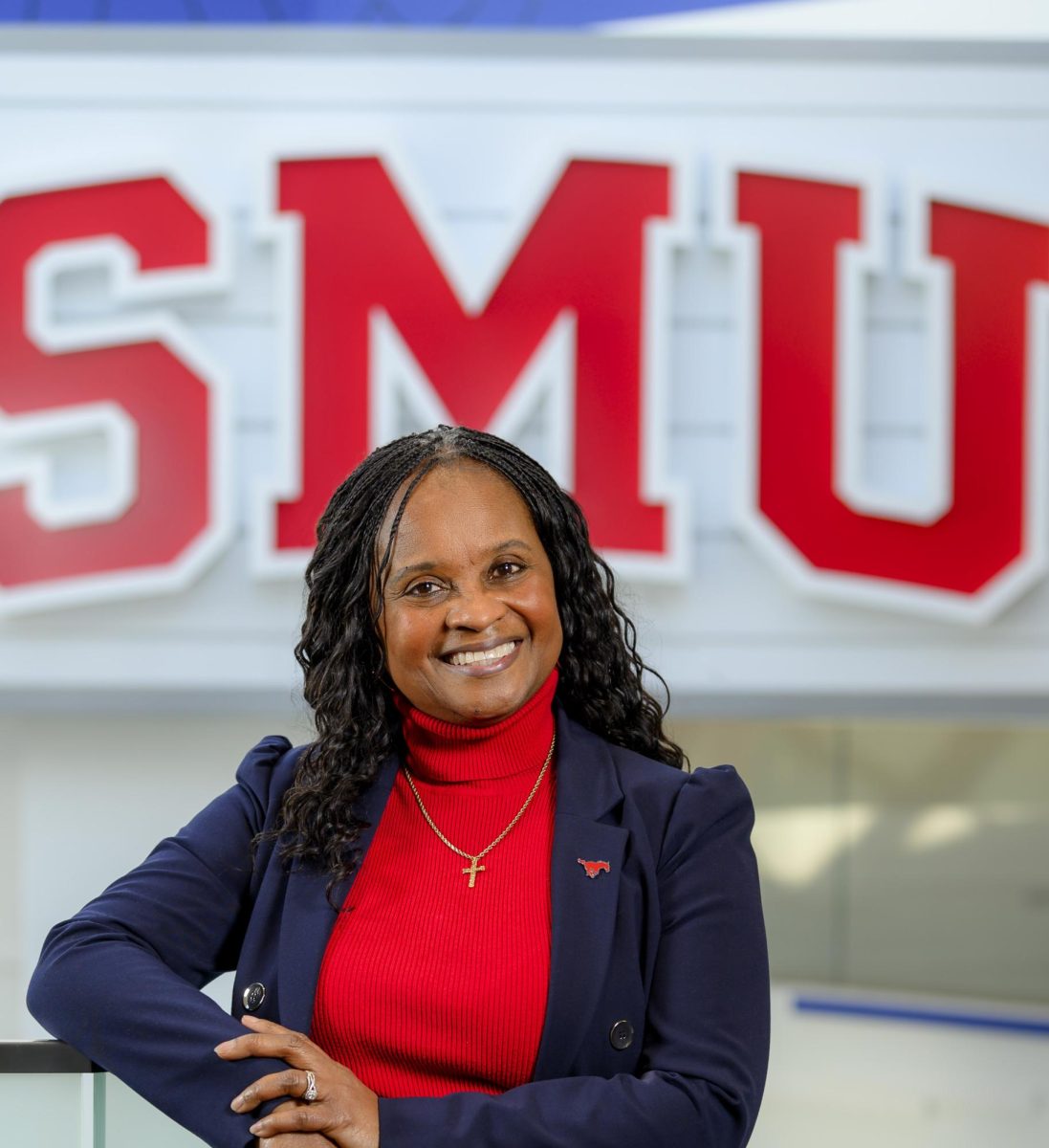



When Courtney Morrison, sergeant of the SMU Police Department, struts across the Boulevard in her police uniform, her stoic demeanor brightens. Her lips ease into a small smile. Barely five feet tall, Morrison stands out among her much taller male colleagues, who look like redwood trees next to her. And yet, this difference doesn’t discourage her from keeping her head held high and her hand close to her waist, her gun poking out from her belt. As she walks, her male colleagues nod to her in respect.
A group of students rushes toward her, cracking jokes and venting about their classes. Morrison’s smirk turns into a large grin, and her shoulders relax.
“I want this to be a safe space for people who look like me here at SMU,” Morrison said. “I don’t want there to be a group of people or students who feel like they’re less important than everyone else.”
For years, Morrison had to learn how to overcome the stigma of not being what most people picture as an officer. She’s a Black woman and the youngest in her department. But rather than cowering to these differences, she decided to use them as fuel to be an example for other women and people of color at SMU.
Black officers have long been the minority demographic in law enforcement. From 1993 to 2020, Black people made up just 12 percent of local police officers in the United States, a percentage that is steadily declining as anti-police protests continue to dominate the media, according to Data USA. However, the number of Black female officers is even slimmer, boasting just 3% in 2020, according to the Bureau of Justice Statistics.
Morrison’s passion to be a role model for others makes it easier for students to gravitate toward her, said Ebere Emefiele, a human rights and sociology major.
“She connects easily with students and is able to understand them on a different level,” Emefiele said. “Her personality is welcoming and invites students to communicate with campus police in a safe and respectful environment.
Morrison’s career journey did not start in the classroom—it started in the living room. Growing up, she would rush home from school to binge-watch her favorite investigative television shows.
“I wanted to be like Olivia Benson from ‘Law and Order: Special Victims Unit,’” Morrison said. “She was my She-ro.”
But her imagination of a life of glamour soon faded once she enrolled in a police academy in Arlington, Texas. As a 21-year-old, Morrison was thrust into the world of high-speed chases and drug busts. But the most bewildering part of the job is having to see death almost constantly.
“I can kick in doors, and I can do the high-speed chases, but if Sally wakes up and her husband is deceased, she’s going to call 9-1-1,” Morrison said. “There’s been some gruesome scenes that I’ve seen, and I can vividly recall everything.”
Her race and her gender also added a layer of challenges to her role. At times, she had to prove to both her colleagues and the offenders that she was suitable for the task.
“There are some times where I can give someone a command, and they just disregard it based on my skin color, my gender and my age,” Morrison said. “I’ve had people look me in my face and tell me bad words and call me unkind names.”
But this discrimination motivated her to work even harder. Over the years, Morrison spearheaded criminal investigations as well as events that helped build trust between law enforcement and the students. Her work eventually earned her a spot on the International Association of Chiefs of Police “40 Under 40” list in 2025.
But rebuilding this trust with the student body has not always been easy, especially as incidents of police brutality and injustice continue to spark outrage among people of color.
“I know the reservations that the Black community has with the police department,” Morrison said. “But we’re not all angry, and sometimes we have bad days, but that doesn’t excuse bad behavior.”
For Xavier Mathis, a journalism and English major at SMU, Morrison is one of the easiest officers to talk to on campus.
“I just love Sgt. Morrison,” Mathis said. “She’s so funny and sweet.”
As the rush hour wanes, Morrison stares off into the distance, her face plastered in a smile. Even though the odds are stacked against her as a Black female officer, she is committed to proving to herself and students of color that they can still thrive in law enforcement.
“As long as I hold true to myself, hold true to my morals, then I know that I’m doing it right,” Morrison said.