


Black Students, faculty, staff and alumni in sparkling gowns and pressed suits strut the red carpet as they enter the Hughes-Trigg Ballroom for the 15th annual Association of Black Students’ Black Excellence Ball. Over dinner, attendees share conversation and celebrate the award honorees and scholarship recipients of the evening.
When junior Chandler Boyd’s name is called, he rises from his seat towards the stage as one of the Black Alumni Scholarship winners.
“That was mind-blowing. I didn’t think I would even [win.] I was just happy the event was set up,” Boyd said. “To hear my name be called, and to walk on stage, I called my mom, showed her, she was talking about ‘Oh my god, I’m so proud.’”
Boyd sees this moment as one that has shaped his experience as a Black student on campus.
“To even get the scholarship and academic improvement made me smile so much, and then seeing [my mom] excited made me smile too,” Boyd said.
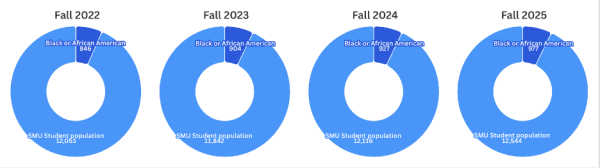
Boyd’s experience is one example of how Black students at SMU shape and redefine campus life. In April, Jazmin Darjean became the university’s first Black female student body president, a historic milestone which she said reflects the progress the university has made since David Huntley served as SMU’s first Black student body president in 1978.
Celebrations like these are a culmination of the progress that generations of Black students, faculty and staff have made at Southern Methodist University over the past seven decades, claiming space at an institution where they were once excluded. From the experiences of one of the first Black undergraduate students to the organizations and students shaping campus today, the story of Black life at SMU is one of resilience, strength and the ongoing pursuit of belonging.
The beginning of the Black experience at SMU started in 1952, when five trailblazers, A. Cecil Williams, James V. Lyles, James A. Hawkins, John W. Elliot and Negail A. Riley, enrolled in the Perkins School of Theology and integrated both the university and Perkins. Perkins was ahead of its time, according to Merrimon Cuninggim, dean of the Perkins School from 1951 to 1960.
“It was the admission of Blacks to Perkins, SMU, in 1952, two years before Brown v. Board of Education, long before Rosa Parks’ revolutionary bus ride, the Selma march, Dr. Martin Luther King Jr’s rise and the Greensboro sit-ins,” Cuninggim wrote in his 1994 book “Perkins Led the Way: The Story of Desegregation at Southern Methodist University.”
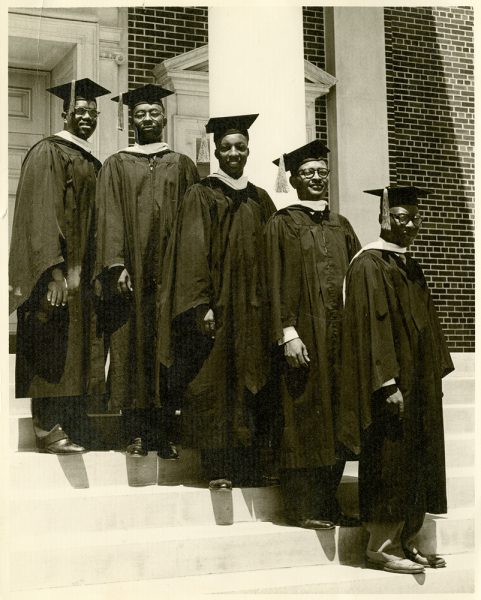
Known as “The Perkins Five,” all of them graduated in 1955, the same year the Dedman School of Law integrated. But it wasn’t until 1962 that the university fully integrated its undergraduate population by admitting Paula Elaine Jones, the first Black undergraduate student at SMU.
Jones graduated in 1966 with a bachelor’s degree in speech, according to an SMU magazine timeline on the institution’s Black history. She started a path for students like Anga Sanders ‘70 ‘77 as more Black students arrived at the Hilltop over the following years.
Sanders is CEO of Global HR Solutions and founder of Feed Oak Cliff, a non-profit fighting food deserts in South Dallas, and initially had no intention of attending SMU. She accepted an offer to her top choice school, The University of Texas at Austin, but applied to SMU after discovering she could not live in the dormitories.
“I think God put me in the right place,” Sanders said. “I needed to be here, and frankly, SMU needed me to be here.”
Sanders arrived on campus at 17 years old in 1966 from her small town of Marshall, Texas, during the height of the Civil Rights Movement. Even though the student population at SMU integrated four years earlier, Sanders was only one of 10 Black students on a campus of 10,000. During the first week living in her all-female dorm, one of the all-male dorms took her hall on a picnic at a park north of Snider Plaza. In a sea of people conversing and enjoying food, Sanders was not acknowledged and sat alone in the grass. Unsure of how to get back to campus, she sat isolated in the park for two hours.
“To this very day, that is the single most humiliating experience of my life,” Sanders said. “I didn’t tell anybody. I didn’t tell my parents, didn’t tell my roommate, nobody, because it pierced my heart.”
Determined to grow from that first impression of life at SMU, Sanders found moments of community by hanging out in Umphrey Lee, the student center at the time, playing cards and dancing to music from the jukebox. She even skated in front of the boys’ dorm quad with her white neighbor. She decided to move in after a spot in her neighbor’s room opened up, as dorm rooms were not integrated. The pair grew to become good friends.
“My first roommate was Black, and she was a really sweet girl. We didn’t have a lot in common; our outlooks on life were a little bit different,” Sanders said. “There were two white girls next door, and I became friends with them, and they were a lot of fun. One of them dropped out first semester, and so I actually moved in with the other one and we had a heck of a time.”
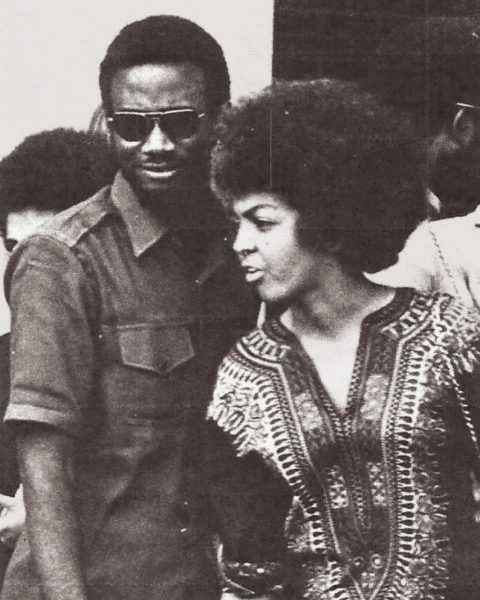
In her junior year, Sanders and other Black students noticed a two-story Confederate flag on the pillars of the Kappa Alpha Order fraternity house during Old South Week. The week was an annual antebellum-themed event in which fraternity members dressed as Confederate soldiers to symbolically secede from the university at Umphrey Lee.
Frustrated by the administration’s lack of action, 19 Black students organized a protest during the mock secession in front of Umphrey Lee. The students dispersed in the crowd, while SMU’s star football player and first Black player in the Southwestern Conference, Jerry LeVias, stood on the top balcony where the flag was suspended.
“When the [fraternity] president said, ‘The South will rise again,’ Jerry took out a pocketknife and cut the ropes. The flag floated gently to the pavement,” Sanders said. “We took out our own little Confederate flags and set them on fire.”
Their actions created change on campus. The Old South Week Secession was no longer held at Umphrey Lee.
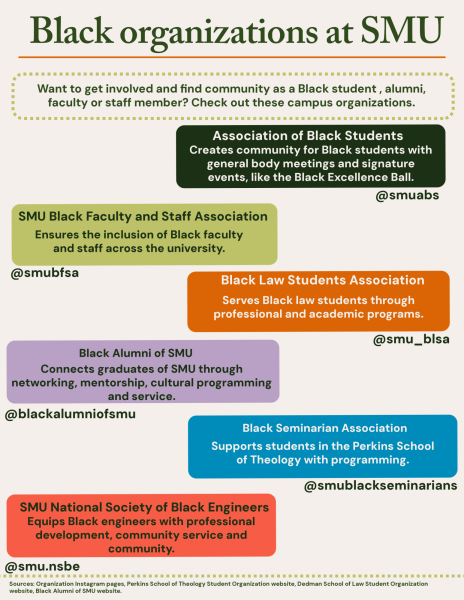
Around the same time, the Black League of African American and African College Students, or BLAACS, was formed by a group of Black student leaders including Sanders and Mike Morris, who served as president. The organization lives on today as The Association for Black Students or ABS, providing a home to Black students for almost 60 years.
Sanders’ choice to attend SMU has shaped the experience and legacy of following generations of Black students on campus.
“I think my presence here, as well as my peers at the time, was impactful,” Sanders said. One thing I know, I will go to my grave knowing I changed this university forever.”
Years later, as the Black community continued to grow, David Huntley ‘80 launched a campaign for student body president in 1978. After an endorsement from The Daily Campus and students mobilizing to elect Huntley as a write-in candidate, he became SMU’s first Black student body president.
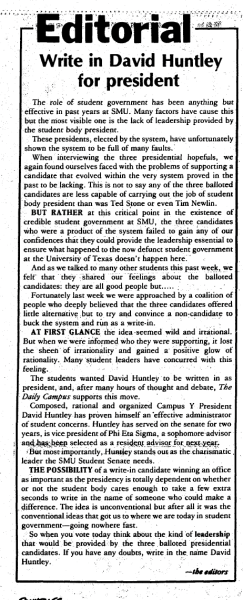
(DeGoyler Library)
Huntley, who retired from AT&T as senior executive vice president and chief compliance officer in 2023, recalled sitting in an evening class at Dallas Hall when a group of Black students ran inside to tell him the news.
“They rushed in, and they said, ‘You won! You won!,” Huntley said. “It was not just a big moment for me, and not just a big moment for all of the people who supported me in that campaign, but especially for Black students.”
Running on a campaign of access and accountability, Huntley hoped to reach a student body that was largely apathetic to voting in both campus and local elections.
During his presidency, Huntley not only expanded the Student Senate’s presence on the Hilltop, but his leadership also created change far beyond campus. He spoke before the Texas State Legislature, representing students attending private institutions across the state, for the successful continued funding of the Tuition Equalization Grant.
“[The Tuition Equalization Grant] is a grant that helps middle-income students go to the school of their choice,” Huntley said. “I got to speak at a luncheon along with the governor, the lieutenant governor [and] the speaker of the house. That was a highlight.”
Huntley’s leadership at SMU allowed him to advocate for students across the state, which he is still passionate about today as a member of SMU’s Board of Trustees.
“It was not just thinking about students and the SMU campus, but it was broader than that; it was ‘What should students be about, how can we be the beacon of how it should be done?’” Huntley said. “I chair the Student Affairs Committee on the Board of Trustees, and it is awesome to see how far students have come, how they’ve grown and how much pride people have in their institution. It’s a good thing.”
Lauren Driskell ‘06 is among the Black alumni who continue the legacy of Sanders and Huntley as chair of the Black Alumni Board and workforce development and inclusion senior project manager at Vistra Corp. She works to build and preserve the legacy of all Black students at SMU.
“I’d love for everyone to get involved, even if they’ve had a bad experience,” Driskell said. “I think that [through] those bad experiences, hopefully we use it as a reference of what we don’t want to happen at the university, and then we can try to see how we can build positively and a way forward.”
The board serves Black alumni and the broader Black community at SMU by organizing social and networking events, providing scholarships to current students with the Black Alumni Scholarship and strengthening school pride.
“In my capacity as chair, I help to drive our efforts to connect with alumni, [and] also be an advocate and voice for students,” Driskell said.
Driskell found the transition to campus challenging despite growing up in predominantly white spaces, but that changed after joining the Association of Black Students in the second semester of her freshman year.
“That’s what really made me find my home, and find something that was meaningful,” Driskell said. “It made the world of difference to my experience.”
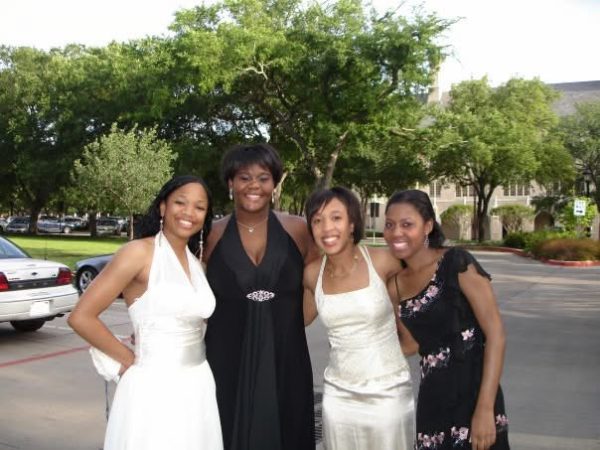
Through an ABS retreat, Driskell met Sanders and was empowered by the experiences of SMU’s first Black students.
“That really instilled in me, [that] other people have gone through a lot to get here and so I think I valued my experience even that much more,” Driskell said. “It also showed me that people have fought really hard to say that we deserve this place and so I should take that seriously and know that I deserve to be here regardless of what anyone else says.”
After joining the Black Alumni Board following her graduation in 2006, Driskell continued to mentor current students, in some cases supporting students before they even set foot on campus.
Devean Owens-Toler Ph.D, ‘14 ‘16, now associate director of Seamount Research Insights at EAB, said Driskell connected her with support systems throughout the Black community before her freshman year started. Owens-Toler collaborated with Driskell on events like the Black Excellence Ball, which Owens-Toler created as an undergraduate and is now a signature event on campus.
“She’s been someone that I consider extremely supportive of Black students at SMU and really trying to make sure that the current students have support and have what they need,” Owens-Toler said.
Stories like Owens-Toler reflect a broader aim of legacy and connection by past generations that current students feel today.
Chandler Boyd, a junior double majoring in operations research engineering management and business administration, found his close friends through ABS and currently serves as treasurer. The Social Change and Intercultural Engagement office on the second floor of Hughes-Trigg, though, is Boyd’s go-to spot for support among students and staff of color.
“It means everything. If I didn’t have that, I wouldn’t be here,” Boyd said. “The SCIE is where everybody is. The SCIE is a great place. It’s like a family in there.”
Boyd is proud of the continued growth of the Black community and the impact student leaders have on campus with the university administration.
“We’ve had dinner with presidents, dinner with very important people that you never even thought you would get in a room with back when you were in high school,” Boyd said. “It’s given the minorities on campus more of a voice because we’re speaking to higher-ups who can also help with the stuff we go through.”
That doesn’t mean things are perfect for Black students today. Boyd shared a moment when he and two friends were walking down the Boulevard from a photoshoot when a rock narrowly missed them, flying out of a moving car with a group of young white men inside. They reported the incident to SMU police, but nothing was done, according to Boyd.
“He [missed], thank God, because they were going, 40, 30 [miles per hour],” Boyd said. ”Being a person of color, they expect you to be aggressive, they expect you to retaliate, which is only going to make us look bad.”
While upperclassmen like Boyd have found their footing after a few years on the Hilltop, newer students like freshman Abigail Sirngot are starting to build their support systems.
“Overall, [the experience has] been pretty good. I found my group of friends, my Black people here at SMU, which I didn’t know I was going to find, especially with it being a [Predominantly White Institution,]” Sirngot said.
A biology major, Sirngot is looking to go into the medical field and has found mentorship through her professors.
“My lab professor, she’s this Black lady from Austin also and I really love her class,” Sirnot said. “Seeing someone where you want to be, that’s amazing.”
As she navigates academic and social spaces on campus, Sirngot has dived into the community by joining ABS, the African Student Association and pledging Alpha Kappa Psi, a business fraternity.
Looking towards her next three years on campus, she hopes to branch out to diverse communities on campus and pay it forward to mentor future students.
“I hope to be someone who makes an impact on campus, and someone who branches out and can be someone that you can rely on,” Sirngot said. “Potentially be a mentor later once I have more experience in what I’m doing, helping other pre-meds and other people trying to find their path.”
Huntley said he has “so much hope” when he sees the accomplishments of current Black students like Boyd and Sirngot reflect the impact of generations of Black students who fought to create spaces of belonging on campus.
“I have so much hope. Every time I’m around you all, I’m completely blown away,” Huntley said. “I’m so proud of students, I’m so proud of Black students here, because you’re not shy, you’re not sitting in the corner of the student center playing dominoes or spades.”
For Sanders, seeing current Black students thriving on campus affirmed that the work she and her peers did was not done in vain.
“You are the culmination of our efforts. We can sit back now and say, ‘It wasn’t all in vain.’ They took the baton and ran with it.’” Sanders said.
Editor’s Note: This story has been updated to reference The Daily Campus’ previous reporting from Jazmin Darjean’s student body president election win in April.