

Editor’s note: This story was updated to include the full title of the museum in the first paragraph and an updated headline.
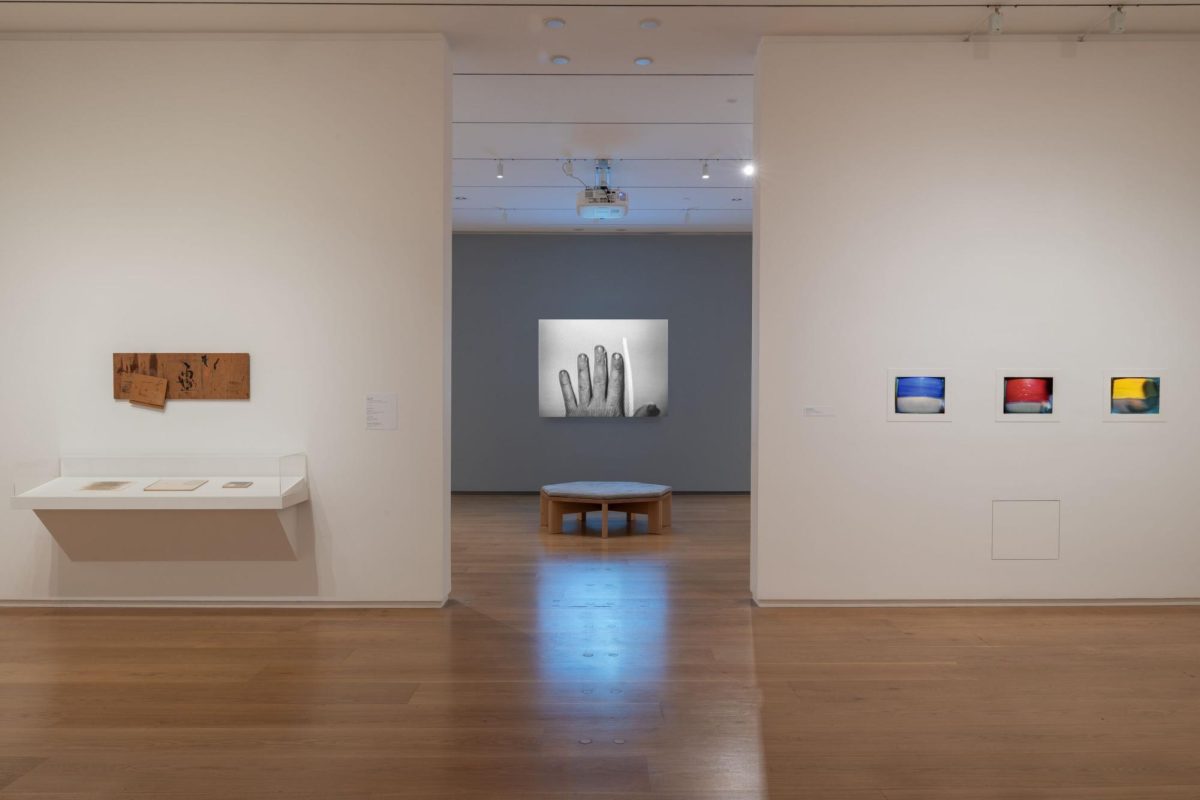
The Menil Collection’s newest exhibition at the Menil Drawing Institute, “Lines of Resolution: Drawing at the Advent of Television and Video,” explores how artists from the 1950s through the 1980s incorporated early television and video technology into their drawings.
The exhibit is co-curated by Dr. Anna Lovatt, an associate professor of Art History at Southern Methodist University. Her 2022 research fellowship at the Menil Drawing Institute sparked her interest in creating an exhibition surrounding early television.
“I was invited to develop a research project partly using their collection, but also thinking more broadly about modern and contemporary drawing,” Lovatt said. “Throughout my research, I had become more interested in experimental drawing practices in the 1970s, especially practices that involved screens.”
The exhibition features more than 50 works by 25 artists who explored how early television and video technologies shaped new approaches to drawing. Many of the pieces use screens and performance to question political conditions, gender norms and the influence of mass media. Others examine how video can shift communication and disrupt televised messages.
A central theme of the exhibition is the technical meaning behind the title, “Lines of Resolution.” Lovatt said the term refers to the image quality in television and video while also incorporating the idea of linearity. The exhibition is about the practice of drawing and how it encounters these new mediums.
“The ‘lines’ refer to the horizontal and vertical lines on a TV screen that tell you the amount of detail that particular screen could reproduce,” Lovatt said. “The ‘resolution’ communicates this resolve or commitment that these artists had to experimentation.”
Among the exhibitions most significant work is Nam June Paik’s “Zen for TV,” created by removing internal magnets from a television so it displays a single line down the center of the screen. Another includes a piece by Brazilian artist Letícia Parente, created under her country’s military dictatorship. Parente applied tiny sheets of paper to her eyes and lips before drawing over them, blending the act of putting on makeup with a commentary on censorship.
“A lot of the works are surprising if we walk into a drawing institute expecting to see framed works on paper on the wall,” Lovatt said. “This exhibition has a lot of moving images, a lot of shifts in scale, a lot of different objects that are surprising to see in that context.”
The exhibition is on display at the Menil Drawing Institute in Houston, Texas, from Oct. 4, 2025, through Feb. 8, 2026.