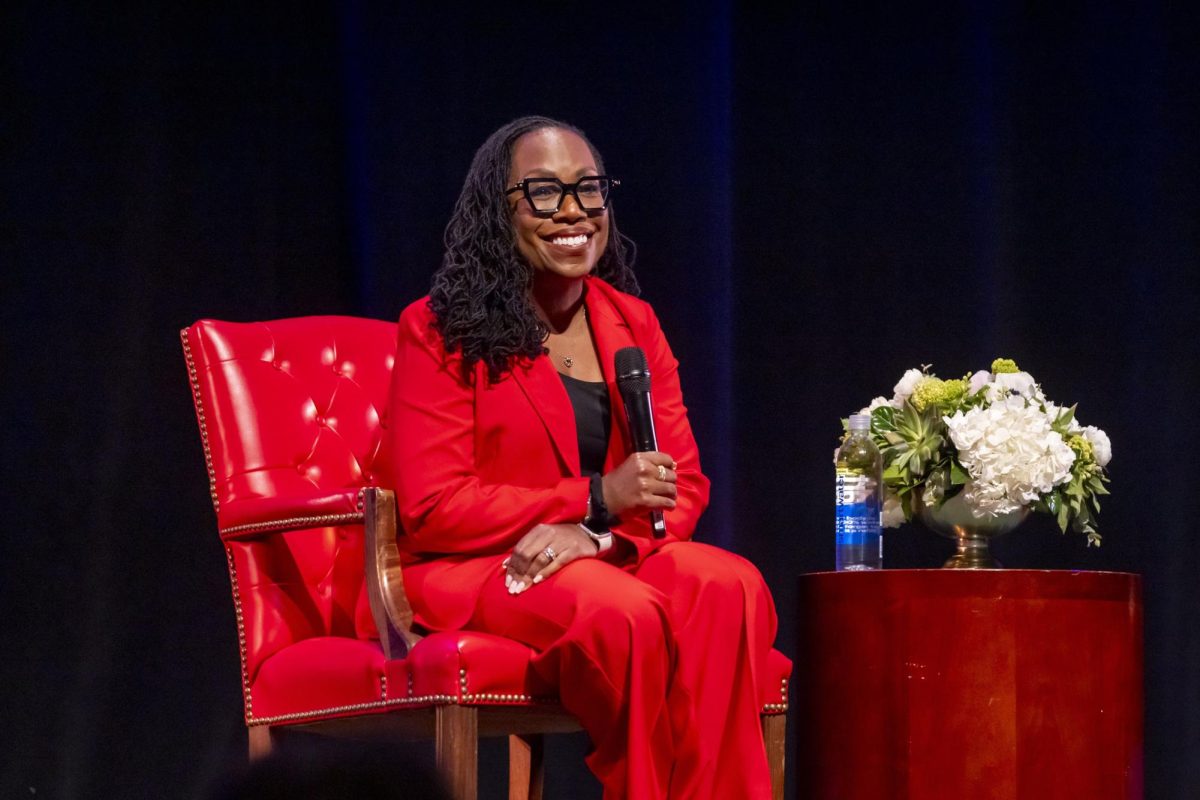



From deep-sea dives to spaceflight, Victor Vescovo has pushed the limits of exploration. Before his Tate Lecture on April 14, The Daily Campus’ copy editor, Abigail Brown, sat down with Vescovo, where he shared what motivates his work and how those experiences influenced his outlook.
Brown: Over your career, you’ve pursued a lot of land, sea and space exploration, including setting a world record in the deep sea. What initially drew you to taking on those challenges?
Vescovo: I think it just started step by step. I’ve always been really curious. I’ve always loved the outdoors, so I started out by going into the wilderness, into mountaineering and that led to different challenges, really pushing myself. Then, as I got older, that became more dangerous, so I was looking for a different challenge that was more technical, more resource involved. That took me into the ocean, which in some respects is a much harsher environment, and one thing led to another. That led me to the ocean, to land, sea and then space.
Brown: Can you tell me more about the Artemis project?
Vescovo: Artemis has been an extraordinary adventure. What I am most proud of is the fact that we’ve now sent human beings further into space than any humans in history. I think that helped reawaken in people a sense of exploration, desire and curiosity. But it was amazing to see them work problems in one of the most difficult environments in the world, which is space and then to make it safely down. To see their enthusiasm, their professionalism, everything that I think is the best that human beings can be, they epitomize. It’s just a wonderful experience. I got to watch the splashdown with four astronauts, which was pretty cool.
Brown: You’ve previously described yourself more in the terms of industrial private equity than as an ocean environmentalist in one article, back in 2023, including what first drew you into ocean-related work. What continues to motivate you today?
Vescovo: Well, I’ve always loved the ocean. I learned how to scuba dive when I was in my early 20s. I love the environment. I spent 20 years in the U.S. Navy as a reserve officer. I spent a lot of time on the ocean and [on] Navy ships. But I think what really drew me back to the ocean was not really ocean exploration, per se, or marine biology. It was the technical challenge. Designing and building a submersible that can go all the way down almost 11,000 meters into the ocean is an extremely difficult technical challenge. As a pilot, I love to fly vehicles, and this was a new opportunity to fly something new, a submersible. Over the course of many years, we designed and developed what became the most advanced deep-diving submersible in history, and I got to pilot it.
Brown: You’ve experienced space flight with Blue Origin. How did that experience shape or shift your perspective on the Earth or humanity?
Vescovo: There’s an interesting effect called the overview effect. It was coined by the Apollo astronauts. It’s the psychological effect of what happens when you see the Earth from space, not just high altitude, but where you really can see the curvature of the Earth and just how thin the atmosphere is. It’s a real thing. I’ve seen a lot of amazing things from the summit of Everest to the bottom of the ocean, but floating in zero gravity and looking down on the Earth and seeing a white sun on a black sky. (it’s white because it’s no longer yellow because the atmosphere isn’t absorbing the different wavelengths) You just get a sense of how fragile the Earth is, and you don’t see boundaries. You really feel this kind of oneness in a way with the Earth and all the people below it. You really do come away from it wanting to be better, to work problems in a more constructive way. You almost wanna take care of what you’re now seeing below you, that’s so beautiful. It’s not like seeing the pictures that you do on the internet or even in print. It’s three-dimensional and you’re floating above the Earth and seeing all of it. It’s just breathtaking. It’s almost indescribable. I don’t think anyone goes to space and comes back worse. You only come back better and wanting to be better.
Brown: Circling back to your ocean exploration, you explored the depths of every part of the ocean.
Vescovo: All five oceans– all five. Our expedition and our team [were] the first to go to the bottom of all five of the oceans, but I then dove another three years, and we were able to descend into 17 deep ocean trenches, which I don’t think anyone had ever been to more than two or three. Every one of them was new, and so with every dive, we discovered new species. We were able to photograph new parts of the sea floor that had never seen [by] the light of a human being. That was just an extraordinary privilege. I’m not, as I say, an ocean scientist, but I felt so proud to be able to enable scientists to go with me and to take people from all different countries, from all different ethnicities and backgrounds, into places that we didn’t have access [to] before. I’m very proud of the fact that before we began our operation, three people had been to the bottom of the ocean and now more than 30 have. We opened a door that did not exist before. That’s what made, I think, a big achievement was [that] we made it normal. It is a big thing. It’s 71% of the planet. I love the quote by the author, Arthur C. Clarke, who said, ‘How unusual is it that we call this planet Earth?’ It’s quite clearly planet ocean.
Brown: Along with the ocean, I also heard that you’ve skied multiple mountains. Vescovo: Well, not necessarily skied them. I did ski to the North and the South Pole for about 100 kilometers each, but I was in my earlier years, [and] I was a mountaineer. For almost two decades, I was into very high altitude mountaineering. I was able to climb to the summit of all mountains that were the highest on each continent, including Mount Everest. Although that took two tries.
Brown: You went from the North Pole to the South Pole?
Vescovo: We were dropped off 100 kilometers from each one of them. Then, for about a week, we skied carrying all of our own supplies to each of the poles. It’s extremely cold, it’s negative 40 degrees, which is the same in Fahrenheit and Celsius. It’s so low. The North Pole is definitely more dangerous than going to the South Pole. The South Pole is very dry. It’s just a straight shot, but in the North Pole, you’re on a polarized cap and it’s moving. There are breaks in the ice where there’s absolutely freezing cold water, and there are polar bears that are sometimes stalking the teams. It’s a much more dynamic environment, so getting to the North Pole was much more of a really big relief.
Brown: This is the biggest question. Is Santa Claus real?
Vescovo: No.
Brown: No?
Vescovo: Well, at least he doesn’t live at the North Pole. Because I spent the night at the North Pole. Not by plan [to stay overnight,] we actually arrived at the North Pole [coming back] from our week-long expedition to get there. The Russian helicopter that was supposed to pick us up, said they had already flown too much that day. [They said] Maybe they would pick us up the next day. We were forced to camp out at the North Pole all night. Then the next morning, [we] get on the radio, and they said, ‘Okay, the weather’s pretty good, we’re gonna try and come get you.’ And that was the most beautiful sight I’ve seen for a while, was that helicopter coming over the horizon. While we were literally at the North Pole, freezing our butts off. But there was no red stripe pole, no Mr. and Mrs. Claus or elves. It was just ice.