


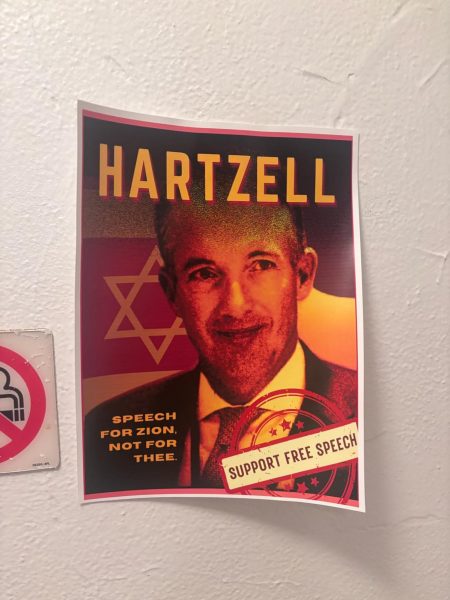
Flyers of President Jay Hartzell with the slogan “Speech for Zion, not for thee” were spread across campus late Wednesday night following Hartzell’s institution of a campus neutrality policy. The party responsible for creating and distributing the flyers is currently unknown.
Sophomore Brianna Gapsiewicz told The Daily Campus that she discovered the flyers late Wednesday night on the Dedman College sign on Dallas Hall Lawn. The flyers illustrated Hartzell in a red filter in front of an Israeli flag, his name emboldened on the top of the page with the slogans “Support Free Speech” and “Speech for Zion, not for thee” at the bottom.
Gapsiewicz called SMU PD after finding the signs.
“I saw them plastered all over the large Dedman College sign on Dallas Hall Lawn, they were taped to the sign and spread all over the grass,” Gapsiewicz said. “I was kind of taken aback. I was not prepared to see an explicitly-looking propagandistic flyer in real life.”
Flyers were taped to multiple buildings, including Dallas Hall, Fondren Science and Clements Hall. An SMU police officer was seen taking down a flyer posted on the steps of Fondren Library at approximately 12:30 a.m. Thursday morning.
The officer confirmed to The Daily Campus he was investigating these buildings because of the flyers, but declined to comment.
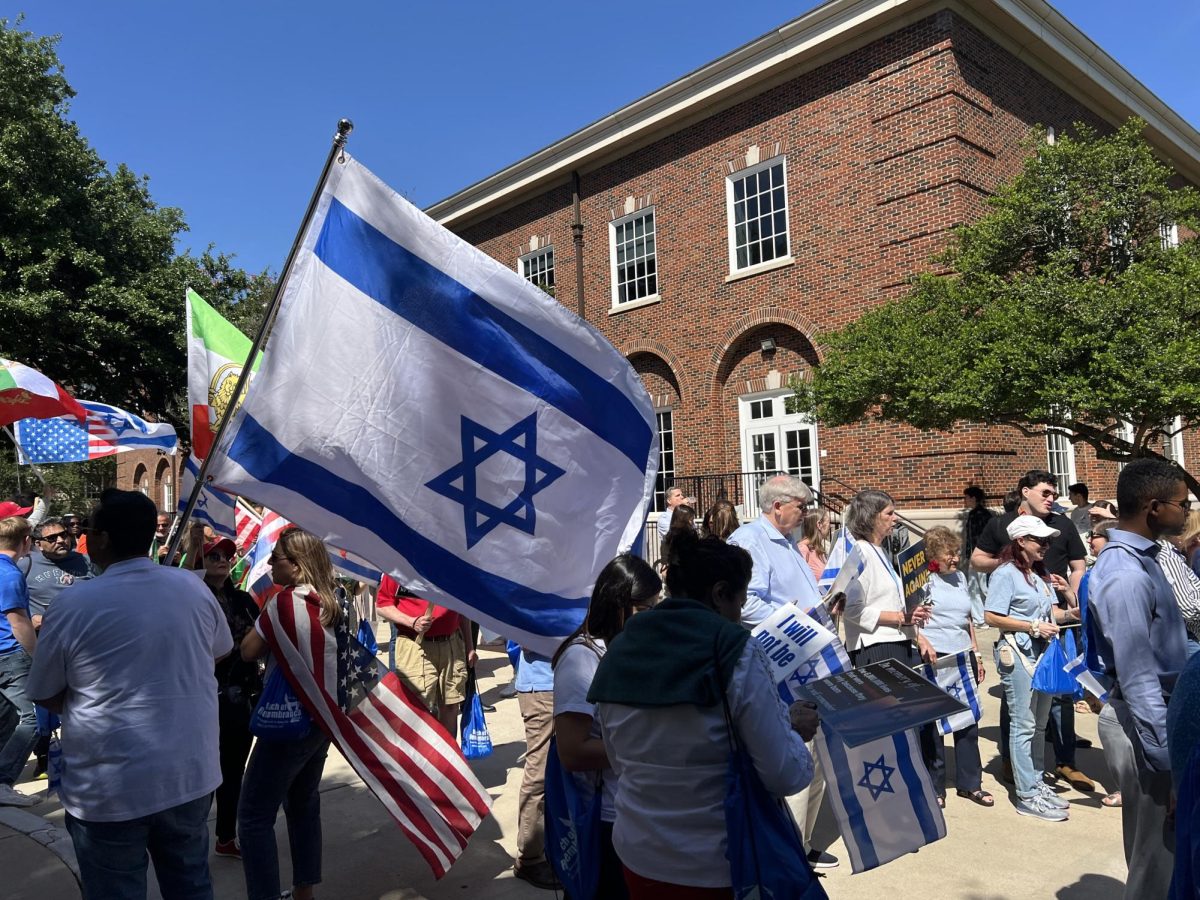
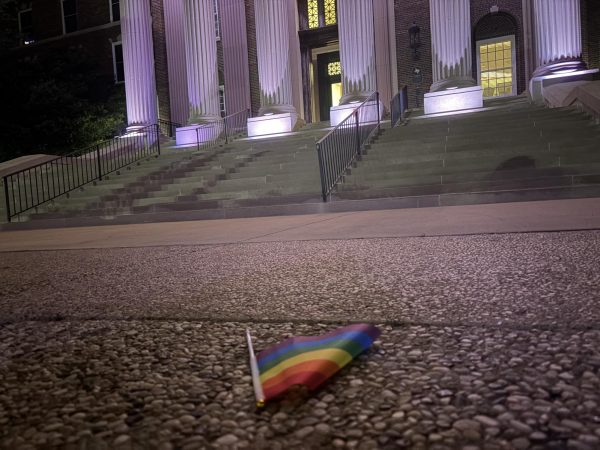
Small Pride flags were also found on Dallas Hall Lawn, strewn across the steps of Dallas Hall and in the Fondren Science quad.
Starting around 7:15 a.m. Thursday, several SMU police officers continued investigating various buildings near Dallas Hall and Clements Hall, removing the remaining flyers. The pride flags at the time were not removed.
The flyers and flags look to be a reaction to the Institutional Neutrality policy, announced by Hartzell via a campus-wide email on Wednesday, April 29. It puts in place the university’s stance that SMU will not issue official statements or support on political or social issues that are not directly tied to the campus or its “ability to pursue teaching and research.” The updated Policy 1.26 supports students in exploring concepts and engaging in open debate without the university itself taking official positions on external issues.
“SMU does not issue institutional statements on external events, issues, or conflicts that are not directly tied to our campus or our ability to pursue our teaching and research,” Hartzell stated in the email. “By remaining neutral, the University ensures that members of the SMU community feel free to explore concepts, ask hard questions and speak openly, without the University’s voice overshadowing their own.”
Hartzell’s email also introduced a caveat to Policy 6.4 in the University Policy Manual, forbidding the display of objects that “alters the appearance of or blocks ingress, egress on transparency of windows and doors” in University-owned buildings.
“A new provision requires that windows remain clear of signs, flags or other materials, so the University’s buildings are not used to convey an individual’s position or endorsement,” Hartzell stated.
The email spread quickly to Fizz, an anonymous posting app for SMU students.
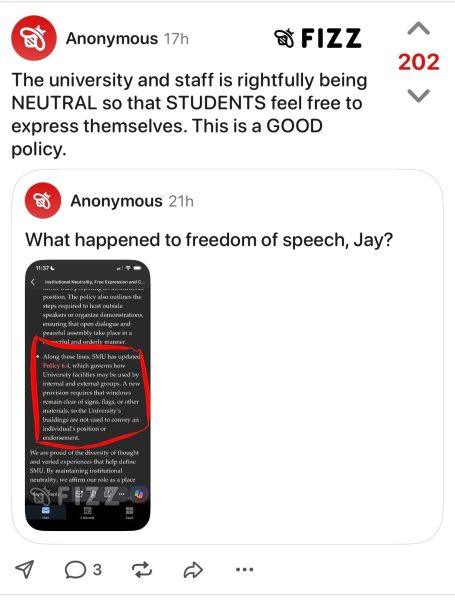
“What happened to freedom of speech, Jay?” one Fizz poster commented. Another responded, “The university and staff is rightfully being NEUTRAL so that STUDENTS feel free to express themselves. This a GOOD policy.”
On-campus protesting started well before the flyers were scattered across campus.
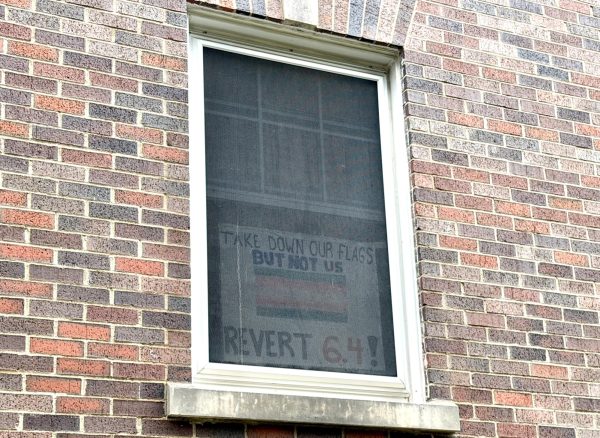
Early Wednesday afternoon, a student in Morrison-McGinnis Residential Commons hung a sign in their window that read– “Take down our flags, but not us. Revert 6.4!” The poster included a drawing of the Transgender Pride flag.
Policy 6.4 applies to all University buildings, including Clements Hall, where the Human Rights office resides. The Humans Rights office has previously posted Pride and Black Lives Matter flags, both of which have since been removed. Dr. Rick Halperin, director of the Embry Human Rights program at SMU, said that nothing displayed in his office window should’ve been considered controversial or political.
“If the university doesn’t want those emblems hanging in the windows, we’ll comply,” Halperin said. “But LGBT rights– that’s not controversial. People may be upset, but they’re upset over a fundamental concept of viewing dignity. The problem isn’t in the displaying of a flag, the problem is the inability of people to grasp that dignity is a fundamental human rights concept.”
Senior Ashley Jones, the former president of the Black Unity Forum, felt that the announcement was vague.
“What constitutes a political flag?” Jones said. “What is a neutral stance? When Oct. 7 happened, there was a lot of Israeli flags on Dallas Hall Lawn. That, to me, doesn’t come across as neutral. I’m just very confused as to why political flags caught a stray on this email.”
Jones said that having flags in windows, whether they were Black Lives Matter, Pride, Israeli or Palestinian, isn’t inherently political– just a demonstration of affiliation.
“One of my friends reached out to me and was like, ‘I noticed [the Black Lives Matter] flag my freshman year. It made me feel like I belonged at SMU because there were people here that apparently supported the Black Lives Matter movement,’” Jones said. “I think that having those up shows support to the students.”
This is not Hartzell’s first time receiving backlash for a policy on free speech. While president of The University of Texas, 165 faculty condemned his administration’s response to a pro-Palestine protest. Hartzell called in multiple law enforcement entities, including armed state troopers.
The Daily Campus has reached out to the SMU administration and SMU Police for comment.