

Editor’s Note: This story has been updated to include the walking times and distance from the Cox school to the proposed East Campus location.
Student and faculty emotions remain mixed about the Dedman Law School’s potential move to East Campus following a public town hall on Tuesday, Jan. 20.
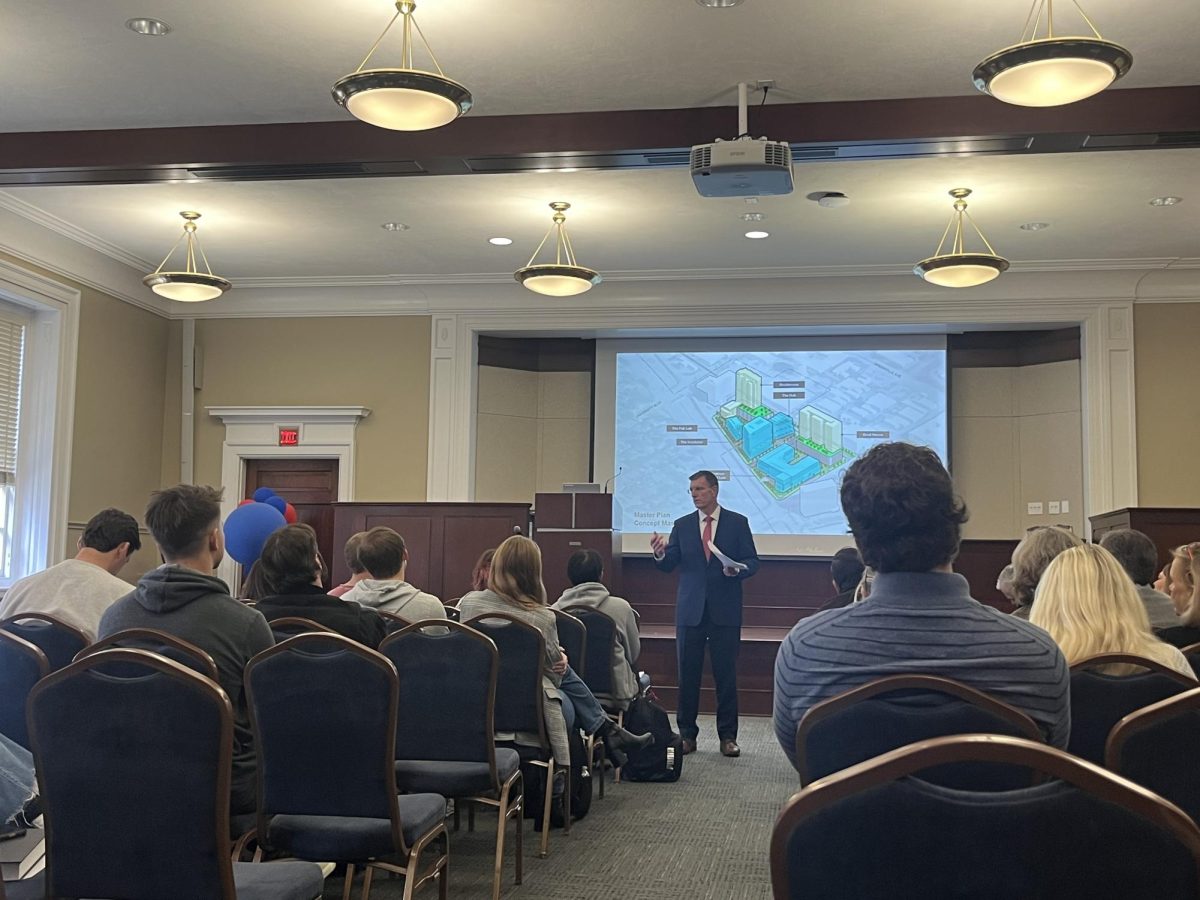
Dean Nance hosted a public town hall, sharing details and initial renderings of the school’s potential relocation in Karcher Auditorium. The town hall, announced in an email by Nance on Dec. 19, was the first official notice law school students received regarding the possible move.
A petition opposing the relocation plan was signed by over 500 people and presented to Nance by third-year law student Christian MacDonald during the Q&A portion. MacDonald created the petition and has been a vocal opponent to the proposal.
“I’m not trying to defend how nasty the bathrooms are; they need to be replaced,” MacDonald said in a December interview. “Some of the classrooms are old enough that it’s already interfering with classes… so it’s already at the point where you need to update the facilities, whether you build a new campus or not.”
In addition to recognizing the need for better facilities, Nance began the town hall by outlining the law school’s objectives for the coming years. Topics included average LSAT and undergraduate GPAs for students, SMU’s bar passage rate and the U.S. News and World Report ranking. “We want this to be a top 20 to 25 law school over the next five to seven years,” Nance said.
Currently, Dedman Law is ranked No. 43 nationally. Compared to other schools in the DFW area, SMU is ranked higher than the University of North Texas (No. 163), but lower than Texas A&M (No.22), whose law school resides in Fort Worth despite the main campus being in College Station.
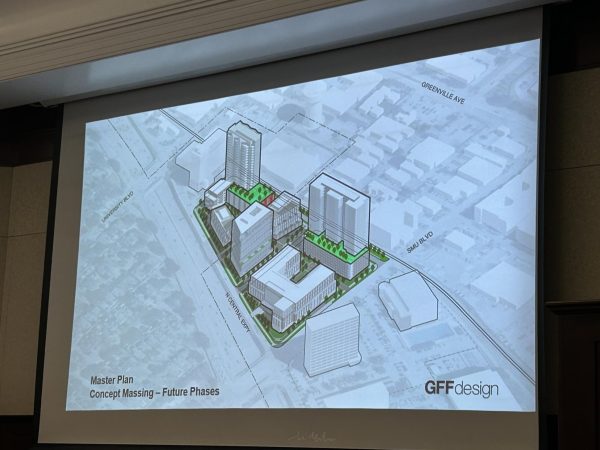
As Nance reviewed the initial renderings of what the law school on East Campus would look like, he said the relocation plan would not begin for at least three or four years.
“This is not going to affect any of you directly,” Nance said.
The renderings and plans were divided into phases, with phase one representing the construction of the new law school building and a graduate housing tower.
In an interview with The Daily Campus on Dec. 10, Vice President of Student Affairs K.C. Mmeje said that one of SMU’s weaknesses across all graduate schools was the ability to provide affordable housing.
“Currently, we have very little housing inventory available for graduate students, and that complicates our ability to be able to recruit,” Mmeje said. “I’m glad we’ll be able to address that need with the law school on East Campus.”
A concern of many current students is the distance and accessibility from the main campus to the new campus. The proposed law school building will be across the North Central Expressway on SMU Boulevard. Nance said ideas are being generated now to ensure students have safe, accessible travel between the campuses.
“The distance between the law school and Cox is about the same as it would be from the new campus, roughly,” Nance said. “Not perfectly, but it is roughly about the same.”
This comparison was also shared in an SMU press release published on Dec. 19 titled “Exploring a Vision for the Future of Campus,” answering frequently asked questions about the relocation.
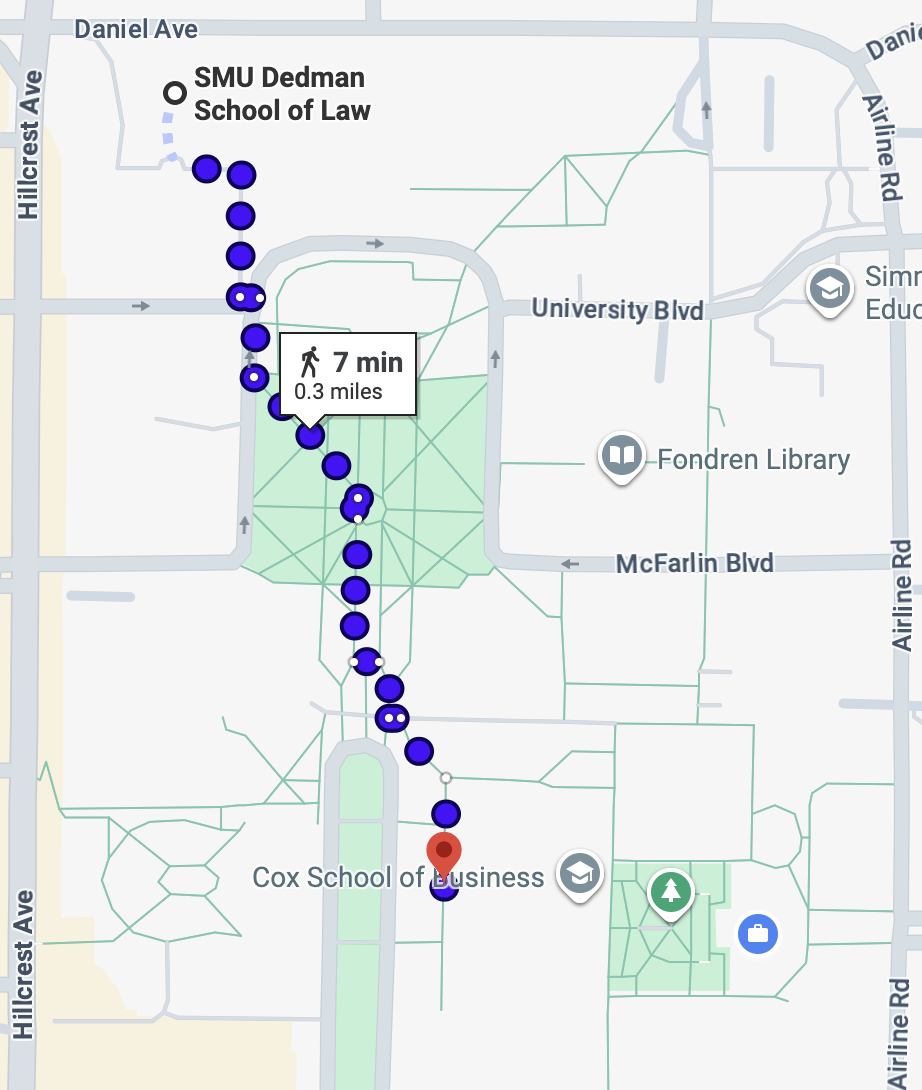
Google Maps currently estimates the walk from Dedman Law to The Cox School of Business is around 7 minutes or 0.3 miles. The map estimate from Cox to the proposed site is almost twice as long, at around 12 minutes or 0.5 miles.
“[Dean Nance] did a good job at answering all the questions, but I mean, we could tell that he’s not the one who’s making the final decision,” said Emily McAnally, a second-year law student.“It’s [President] Hartzell pulling the strings.”
During the meeting, McAnally raised potential parking and traffic congestion concerns on U.S. 75 and the DART rail line running adjacent to the East Campus location.
“We’re right by the DART rail, and I think that would be nice if we had a specific stop just for us,” McAnally said.
Assistant Dean for Graduate and International Programs Martin Camp graduated from Dedman Law in 1979 and is optimistic about the changes to come.
“When I first heard about it, I was nostalgic and sad. But then I thought, change isn’t always bad,” Camp said.
Camp has seen past plans to renovate the school fall through, leaving some campus facilities largely unchanged for decades.
“We’ve been trying to renovate these buildings. The last dean tried for seven years to raise much, much less just to renovate Florence [Hall], and wasn’t able to do it,” Camp said. “When I go to the bathrooms in Florence, they look exactly like they did when I was here in 1976, including the broken tiles.”
Many students remain upset at the lack of input they’ve been allowed to give to the administration so far. Second-year law student Emma Suvorov said that she was disappointed to learn in the town hall that student input will be limited to implementation details.
“When I asked whether President Hartzell plans to meet directly with law students, Dean Nance said he does not,” Suvorov said. “There seems to be room for conversation, as long as you are suggesting what flowers to plant at the new location. The underlying decision [to move] is not up for debate.”
Some professors wanted their voices heard, too. In November, 19 of 27 full-time, tenured professors in the Dedman Law School signed and sent a statement of concern to the Board of Trustees. Associate Professor Carliss Chatman, one signee, said the professors first scheduled a meeting with President Hartzell before bringing their concerns to the Board of Trustees.
“It was decided that we should have a separate meeting with the president if we could, and that we should also have a statement ready for that meeting,” Chatman said. “That’s when [Hartzell] said he wasn’t going to change his mind, done deal.”
After the meeting with President Hartzell, the professors pivoted and wrote their letter to the Board of Trustees. In the statement, the 19 signees expressed their concerns with the lack of transparency, the noise on East Campus and the loss of connection to the main campus.
“To be clear, we believe that the current Law School buildings should be renovated or rebuilt, and we have provided extensive input on the existing architectural plans to do just that,” the faculty statement said. “The Law School should be able to count on the University’s support with these renovation plans, into which substantial resources have already been invested, without having to give up its campus location.”
While more details about the new East Campus buildings hang in the balance, the fate of the four buildings that make up the current law school quad is also in discussion. President Hartzell said the area would continue to be used for undergraduate students.
“We would like to have more, straight academic space: faculty, classroom, student support,” Hartzell said in an interview with The Daily Campus on Dec. 10.
The “Exploring a Vision for the Future of Campus” press release matched Hartzell’s message, stating that the move “frees up the current site for undergraduate academic expansion.” However, decisions for the former law school buildings will only be made “after thorough planning, consultation and fundraising.”