


Editor’s note: Rosian Bargiansky Zerner is a Holocaust survivor.
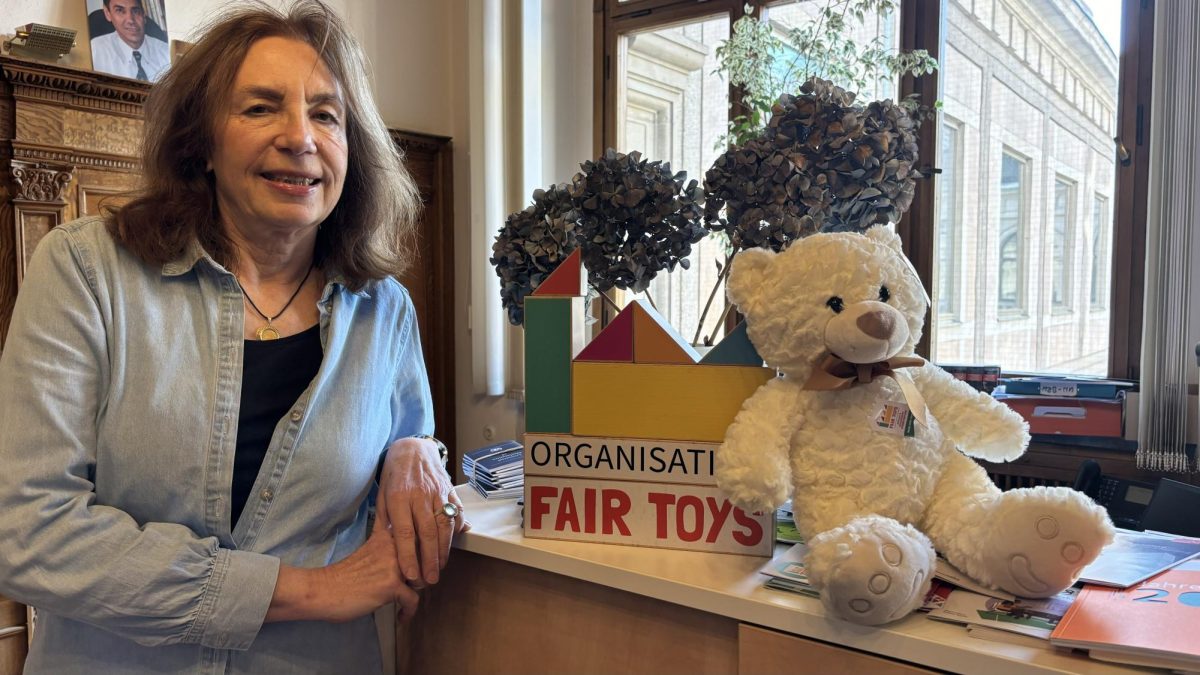
Holocaust survivor Rosian Bargiansky Zerner was born in 1935. When she was a young child in Kaunas, Lithuania, her life turned upside down. Adolf Hitler’s Nazi regime spread across Europe as they rounded up Jewish people and other minorities, which included herself and her family. Now, living in Dallas, she uses her journey to speak out against hate.
This interview has been edited for length and clarity by Elle Caldon and Evie Doles.
DALLAS — Hitler lost.
I’m 90 years old. My mother lived to 101, my father to his 90s. I have two children, and they have two children. This just shows the continuity of Jewish life. And Hitler lost.
I was born into a privileged family. We had a chauffeur and a car with a three-digit license plate because there were not too many cars in Lithuania at that time. My father graduated from military school and became a lawyer. Then, he couldn’t practice because he was Jewish, so he started a textile export there.
I was five or six years old when people and laws were beginning to be bad toward Jewish people, so I was very accepting of what was around me. I had a German Jewish mother. I couldn’t understand why we had to leave and why we didn’t have our luxuries that we were used to. We were interned in the Kovno Ghetto, which became the Kauen concentration camp. We were told to take whatever we could. My mother took this huge plant that, of course, froze in the winter.
That’s what I remember mostly: that plant freezing and then us freezing because there was no heat. To drink a glass of water, we had to melt the snow and quickly bring it to our lips so it wouldn’t re-freeze. Each day, we had 700 calories of food that wasn’t really food. I still remember the taste of frozen potatoes. Really dreadful.
We lived in this 10-by-10-foot little shack. There was no heat. We had to step over each other just to get to our beds. The walls were blood-stained when we first entered, and I remember my mother scrubbing them.
My paternal grandfather was tortured and humiliated before the Nazis killed him. My paternal grandmother was also murdered, even before the Germans came. She stood in line and had forgotten to wear the required yellow star. A neighbor denounced her, and she was never seen again. Things were happening that I couldn’t comprehend, but I followed as someone who thought tomorrow would be a better day.
My parents saw what was happening. They couldn’t understand it because this was at the beginning of the war. Lithuania was one of the first to be occupied because the Lithuanians welcomed the Nazis and collaborated with them.
There were some good Germans. My father was given freedom by a German. I had a German rescuer. But the Nazis, specifically, were the ones who made us suffer, brutalized us and were sadistic.
Children, like me, and the elderly were disposable; they weren’t useful. Therefore, my parents decided that I should escape the ghetto.
Barbed wire surrounded the ghetto. There were searchlights, dogs and guards patrolling on top of a structure. My parents were my first rescuers. They timed the changing of the guards, and in those couple of minutes, they dug a hole under the barbed wire at their risk. One day, they pushed me through.
My father’s secretary was waiting for me in the shadows outside, and we ran over the bridge to her apartment. I was crying nonstop. She decided not to keep me because I posed too much danger to her. She gave me her Christian name, and I am grateful for what she did. From then on, I was on the run and in hiding.
Lithuania is a country where over 90% of the Jews were murdered. My mother and my father survived: my mother spoke fluent French and pretended to be a French woman whose husband died in the war, and my father was rescued by his boss, who got him out of the ghetto.
My mother came to visit me once during the war. I lived on a farm with a woman named Lida, who was my main rescuer. She brought me my only toy during the war, a doll made of wool scraps. I treasured that doll until it disintegrated.
After the war, we were all reunited. My father was asked for an outstanding business position by the Russians, and then they realized he was Jewish, so they had a meeting about him. We didn’t wait for the results, and we escaped. We went to Gdansk, which is now in Poland, and from then on, we went to different countries with different passports all the time. We ended up in prison in Hungary because we always spoke Lithuanian, which nobody could understand.
My father was so resourceful. He got us out. We became part of a displaced persons camp in Austria, which was divided into four sections. After the war, we were in the British sector, and they were very sympathetic to the people that they were welcoming there. There was something called the Jewish Brigade, a group of Israelis who were trying to help Jews. They stole 24 trucks from the Austrian government and drove us into Italy. So we settled in Milan, Italy, for six years. It was the first stable place that I had been for a while.
However, the Korean War broke out, and my father said, “We want to go to a country where, if there’s a war on the soil, it’s the last war on Earth.”
Suddenly, we were in America. I was put in the ninth grade without knowing English. I learned English in three years, and I went to Barnard and graduate school in Columbia.
America gave me a good life, freedom of choice, friends, education that I cherish and a stable life, more or less. Texas has been good for me. The scars are there, but I don’t focus. I disassociate myself, but I feel I have to bear witness, since I’m the last generation.
You have a responsibility now to continue to speak the truth and to be an agent for better. I mean, each one of you can be a prophet for that.
We need to understand that people can be good but also horrible. We need an internal resolution in each human being, as a species that is so capable of doing marvelous things and then chooses otherwise. You have a duty to have a greater view of what truth is and live the truth. Please, become a voice for a better world.