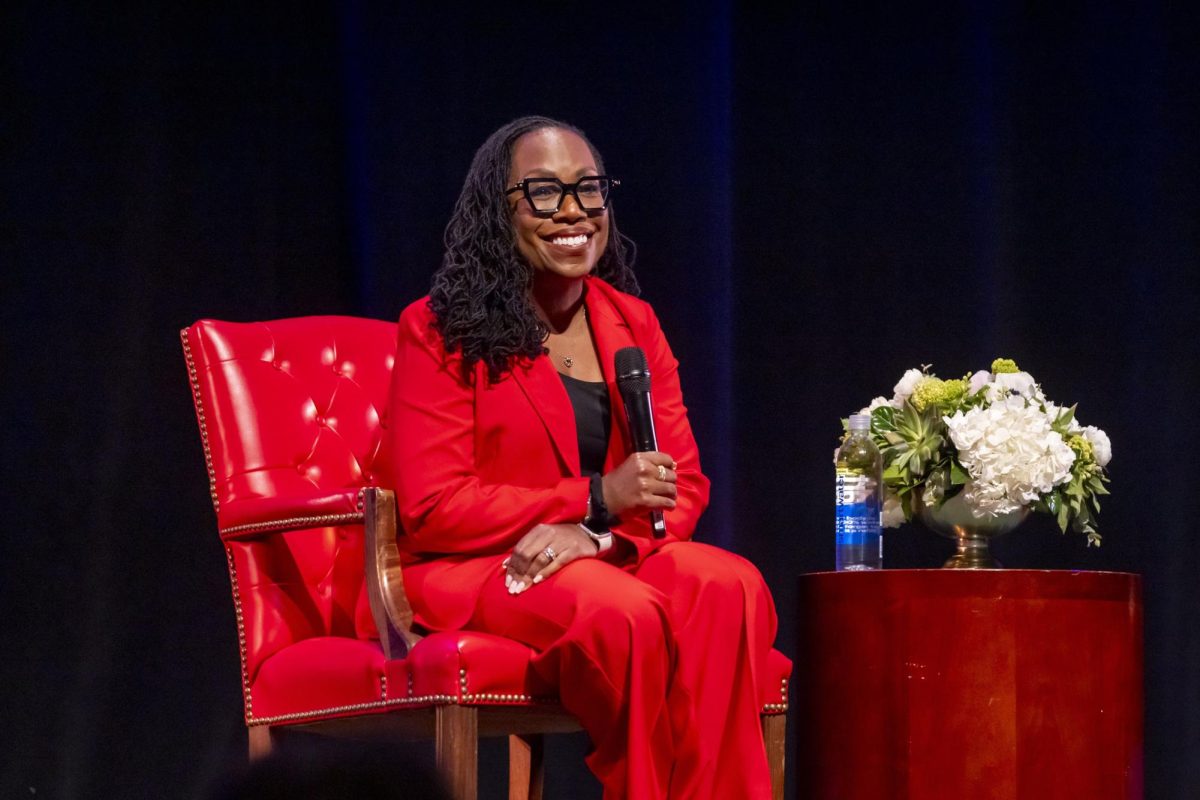



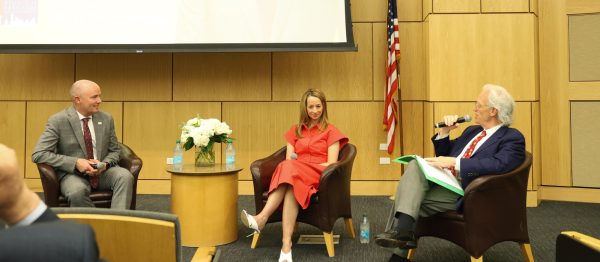
Students, faculty and members of the Dallas community piled into Crum auditorium on Monday, March 30, to listen to Utah Governor Spencer Cox and First Lady Abby Cox talk about having conversations on civil discourse and how to “Disagree Better,” one of Governor Cox’s initiatives.
Provost Rachel Davis Mersey opened the evening by emphasizing SMU’s commitment to cultivating a respectful environment where students and staff can hold differing opinions.
“Civil discourse is not simply about being polite,” Merse said. “It’s about taking each other seriously and embracing the kind of disagreements that free us from the echo chambers, deepen our understanding and strengthen our relationships.”
To start the conversation, Governor Cox reflected on our country’s foundational values and what the true meaning of “the pursuit of happiness.”
“Today, most Americans think that pursuing happiness means the pursuit of personal pleasure or whatever makes you feel good,” Cox said. “That’s not at all what the founders meant by those words. The pursuit of happiness meant the pursuit of personal excellence.”
As he continues, Cox emphasizes the importance of self-improvement and community building as a society.
“If we’re to survive another 250 years, we have to be in groups like this,” Cox said. “We have to challenge each other. We have to listen to each other, and we have to find ways to better ourselves and better the communities around us.”
When asked by the moderator how we got to the point as a society where we attack each other for our beliefs, Cox gave a list of responses, with social media at the top.
“I think social media is just far worse, far more pernicious. It didn’t start out that way,” Cox said. “But it’s when they try to monetize it then the algorithms come in. They’ve gotten so good that the technology is so good that they figure out how to hack our brains. They can find out very quickly what gets our attention and how to hold our attention.”
Cox then explained how social media has caused an increase in depression and anxiety among young people and how this was the intention of social media companies from the beginning. This was confirmed for Cox when he met a former Meta engineer who told him this.
“I was talking to an engineer who worked with some of Meta’s people when they went on Instagram. They had this thing that they told him: ‘Our job is to make people just depressed enough. We don’t want them too depressed, but we want them depressed enough, especially young women, so they’ll keep scrolling and buying products,’” Cox said.
The reason young people can’t get off social media is its addictive nature and the dopamine it releases in our brains. Cox further explained that the same brain chemicals that make social media addictive are also released when people experience outrage.
“They found that outrage releases those same chemicals, so getting people addicted to outrage actually started before social media, [it] started with cable news,” Cox said. “It turns out if we get two people yelling at each other, that works really, really well. Then social media just put that on steroids.”
Cox said it’s this nature that makes social media dangerous and has divided our country.
“That’s where that loneliness creeps in, and now the tribalism on social media that continues to divide us,” Cox said. “I think [it’s] incredibly damaging.”
This message about social media hit hard with the audience. One student, senior Mila Oliva, realized how addicted young people are to their phones and how that has limited their ability to have meaningful conversations with one another, especially when the topic is democracy.
“A lot of us young people on campus are really plugged into social media, which I think a lot of the time can lead us to believe the world is ending,” Oliva said. “I really took away that when you unplug from that narrative and that kind of bubble, you start to realize that people really are out here for the good of bridge building and building up a democracy and a space where we can all agree to disagree and get along with one another.”
One of the central themes of the evening was Cox’s “Disagree Better” initiative, which he launched in 2023 as chair of the National Governors Association. The idea was simple – “When leaders from both parties engage one another with respect and genuine curiosity, they reflect the best of who we are and remind us what’s possible when we do the same.”
Cox recounted back to 2020 when he was first running for Governor of Utah. Cox explained that tensions were high in the country and that people were pitting him against his opponent. He reflected, thinking that at the end of the day, they were both still Americans – sparking this idea.
Cox, a Republican, convinced his Democratic opponent, Chris Peterson, to film a campaign video with him, which showed that although they may not align politically, they can still be respectful towards one another.
“We disagree on a lot of things, [but] we both agree that we love our state. We love our country,” Cox said. “We can disagree without hating each other.”
The video went viral, initiating the launch of “Disagree Better.” Now, 23 governors from both Republican and Democratic parties have joined Cox’s “Disagree Better” initiative, showing U.S. citizens that even in a polarized political space, disagreeing respectfully does exist.
“What Ddisagree Bbetter and what civility properly understood is about, isn’t less debate, it’s more debate,” Cox said. “It’s standing up for what you believe, but doing it in the right way. We think of conflict as having a negative connotation. Healthy conflict is what our nation was built upon.”
As the conversation ended, Cox left the audience with advice to be optimistic and look for the good in our world.
“Stop believing all the negativity that’s out there. Start looking for the good around us, and you will find it,” Cox said. “The more we give back, the more we care about our neighbors, the more we get rid of the identities that divide us and adopt the identities that bring us together.”