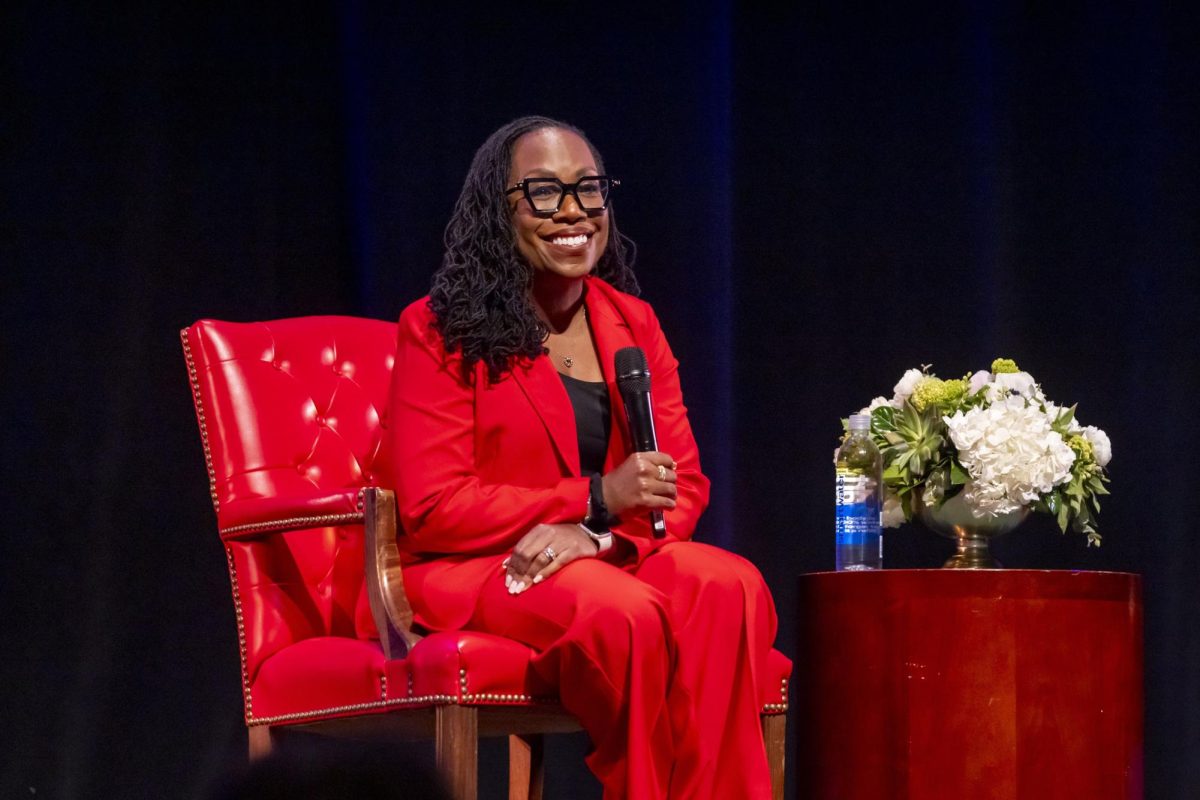



Faculty from universities across Texas and the country came together to discuss academic freedom and classroom censorship at ‘The Freedom to Teach and The Right to Learn” for a hybrid teach-in on Tuesday.
The event included panel discussions and a teach-in, which was organized in conjunction with SMU’s chapter of the American Association of University Professors, SMU’s Women’s and Gender Studies Program and SMU’s Human Rights Program. The event is also one of several being hosted at Texas universities this week.
“We wanted to give an opportunity for faculty from across Texas and elsewhere to come together, talk about these issues with students, and have a platform where we can be very visible in public with this in a way that isn’t possible right now at every campus,” said Alida Liberman, president of SMU’s AAUP chapter and associate professor of philosophy.
The goal of hosting at a private institution, like SMU, was to create a platform in solidarity with faculty members at public universities facing censorship and restrictions from increased state and national legislation affecting Diversity, Equity and Inclusion (DEI) programs and certain course curricula. Each faculty member spoke in their capacity as private citizens and did not represent their respective universities.
The first panel of the teach-in discussed academic freedom and the second examined how women, gender and sexuality courses and STEM disciplines have been affected by censorship and restrictions.
Amy Reid was a professor of French literature and director of the gender studies program at The New College of Florida when the program was abolished in 2024. On her last day as director, Reid witnessed the destruction of the entire collection of gender and diversity books from the university library that students had been collecting for the past 30 years. The books were thrown in dumpsters, where students had to dumpster dive to save them.
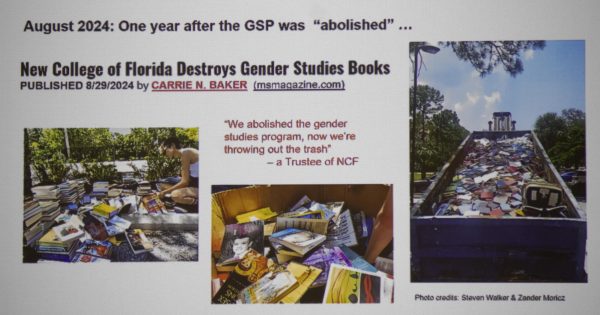
“One of the trustees at New College was really clear that this was about ending the gender studies program, saying, ‘We abolish the gender studies program, and now we throw out the trash,’” Reid said.
Reid now works as program director for the Freedom to Learn team at PEN America, which pushes back against educational censorship across the United States. According to a January 2026 report by PEN America, more than 50% of college students in the U.S. are enrolled in a state that has enacted at least one law censoring higher education.
“That is a stunning number, and it’s something that we all need to attend to and say no to,” Reid said. “This is where we draw the line. This is where we say no to censorship. “
The elimination of programs began in Texas in 2025 after President Trump signed Executive Orders 14151 and 14173, which eliminated DEI programs in the federal government.
At the state level, Governor Greg Abbott signed Senate Bill 37 in 2025, which imposes political control over faculty senates at public colleges and universities and allows university boards to expand power systems.
“What it does not require is a censorship of class material, and no state law in Texas requires the censorship of any course material,” Liberman said. “However, they are still being censored by choice by governor-appointed boards of regents at universities.”
In November and December of 2025, Texas A&M and Texas Tech passed new policies prohibiting courses that teach ideologies and concepts related to race and/or sex. These new policies have caused a lot of strife for professors, especially at A&M. Professor Martin Peterson, Ph.D. of the A&M philosophy department, now have no guidance from university administration to fit their curriculum within the new policies.
Peterson’s class, which taught Plato’s Symposium, was reviewed and censored by the A&M board of regents because the Symposium talked about gender. “Plato, I think, became a symbol, at least locally at Texas A&M, for a bigger product,” Peterson said.
Peterson estimates that A&M’s new policy has led to the censorship of at least 200 courses at the university. As a result, Peterson said he will leave A&M and join Southern Methodist University in the fall as the Elizabeth Scurlock University Professor in Human Values: Endowed Chair of Ethics in Artificial Intelligence.
Tracy Everbach, Ph.D., a journalism professor at The University of North Texas, hasn’t had her teaching censored yet, but said, “It is coming.”
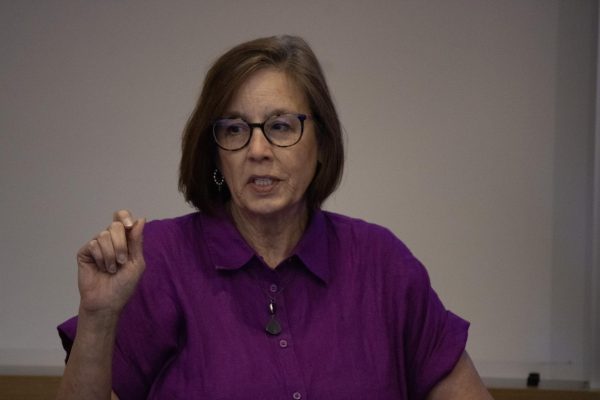
Everbach talked about UNT’s recent censorship of two art exhibitions, one of which criticized ICE, and the firing of a staff member in the university’s social work program after an undercover video published by the conservative group Accuracy in Media showed her explaining how to get around the DEI ban. Texas Attorney General Ken Paxton has since opened an investigation into UNT as a result of this video.
Faculty at UNT are currently undergoing syllabus reviews using AI, Everbach said. The syllabus for Everbach’s race, gender and the media course that she has taught for the past 15 years has been flagged.
“I fully expect to be censored,” Everbach said. “My syllabus [has] already been flagged by the AI, but I don’t know what I’m going to have to do.”
Frustrated by numerous changes the university has made, including the shuttering of DEI offices and the consolidation or closure of over 70 programs, many of which are humanities, Everbach has had enough.
“I’m not quite at retirement age yet, but I’ve applied to take a buyout from the university,” Everbach said. “I’m convinced that the politicians are trying to destroy universities and withhold education from those who want and need it the most.”
SMU law professor Joanna Grossman argued that politicians in the current administration are attacking faculty at higher institutions to discredit their expertise.
“It’s the idea that we will tell you what we need to know, and what we need to know is the only thing we want you to know, and we don’t care if they’re true or not,” Grossman said.
Other professors said biology and genetics get misinterpretated of to justify arguments that support concepts such as racism and sexism.
“Humans are diverse, and we are all part of a complex continuum,” said Tatiane Russo-Tait, an assistant professor of biology and STEM education. “That’s why it’s so important that key subjects like history, sociology, ethnic and gender studies stay alive in our school and colleges, and I argue to teach them alongside, inside [biology classes] because the subjects help us understand that the social labels aren’t hard wired to our DNA but are concepts shaped by how society has treated people over time.”
Gender and sexuality studies have also faced cuts, looking back at the last 15 years, according to the University of Texas, Dallas Women’s U.S. history professor, Annie Gray Fisher. However, 15 years ago, positions in this field were cut for economic reasons; today, they are cut for political ones.
“Yes, things are getting worse in our lifetimes,” Fisher said. “At my institution, the repression has not come yet; we are still waiting, but in my corner of the institution, I’m still free to teach women’s history to hundreds of students every year.”
Professors argued that censorship of classes also affects the students because what the professors are being prohibited from teaching, students are being prohibited from learning.
During one of the Q&A sessions at the teach-in, a student in a philosophy class at the University of Texas, Arlington, asked how students can be a part of the solution.
“Students need to vote and need to vote for the people who are going to advocate for students,” Everbach said. “The other thing is that universities consider students to be customers, so you have a voice. At this point, students have more of a voice than the faculty does. They don’t care what we say, but they do care what you say because they depend on your money.”
SMU freshman Fajor Ahmed, who studies human rights with minors in vulnerable women and gender studies, attended the teach-in and is concerned about what these classes may look like in the future.
“I’m sometimes scared about ‘Will I even be able to graduate with these degrees? Will they be gone by the time I’m a senior?,” Ahmed said.
Ahmed currently serves as outreach chair in the Student Senate and is drafting legislation called Firewall for Freedom that students at other institutions have passed in conjunction with Amnesty International USA and the American Civil Liberties Union. The legislation aims to expand protections for international students at SMU following the waves of censorship against international college students nationwide.
Ahmed is working on the legislation with two other senators, and estimates the draft will be completed next semester to present to Student Senate.
“The main thing is just allowing students to feel comfortable and speaking up,” Ahmed said. “That’s been an issue for students, and allowing them to feel safe at the university and taking classes that they want to take.”
Student voices are the most powerful voices at a university, Everbach said, and encouraged students to be active on social media and with student media.
“I don’t think it has to be a protest,” Everbach said. “I think students can get on social media and start tagging the president of the university, saying this is not the way things should be done, and this is not what we want.”
Editor’s note: This story has been updated to update a quote for accuracy after the source clarified their original statement. Identifying details have also been removed at the source’s request.