


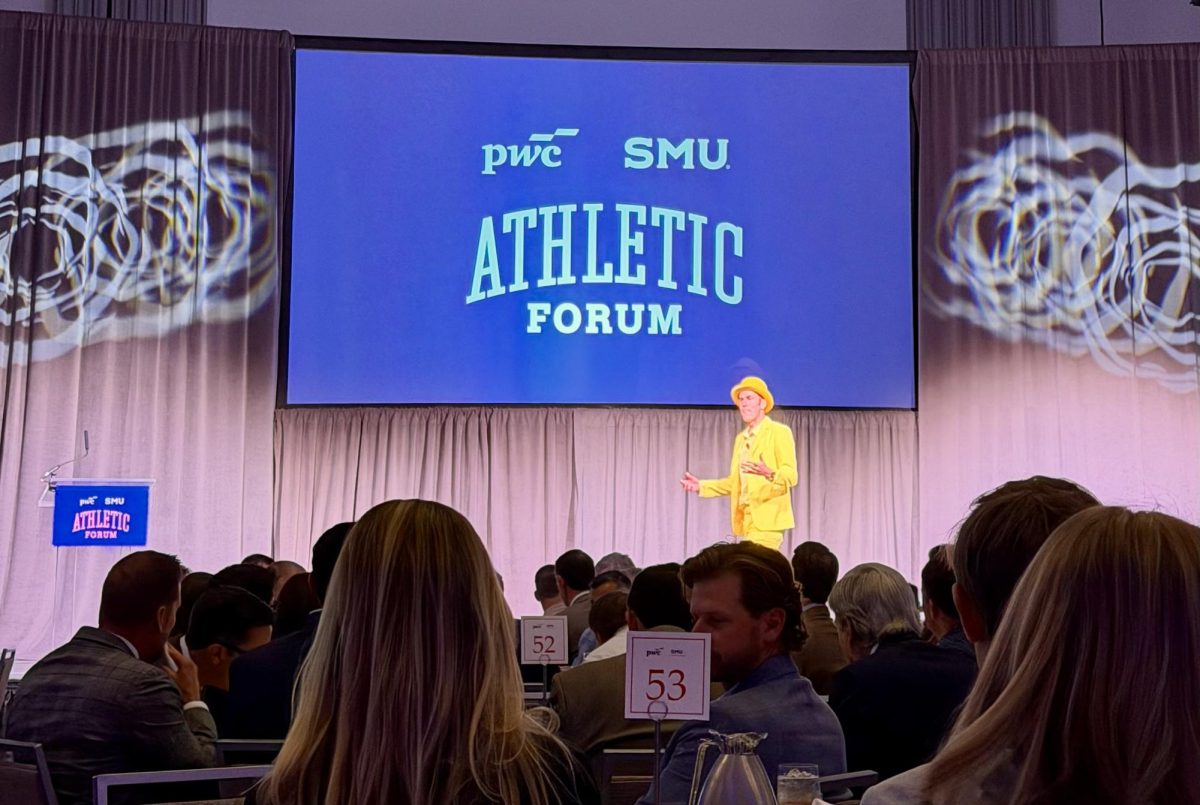
Jesse Cole, owner of the Savannah Bananas, spoke at the Fairmont Hotel in Dallas on Tuesday, April 7, as the keynote speaker of the PwC SMU Athletic Forum.
The PwC SMU Athletic Forum was founded in 1989 to bring keynote speakers in the world of sports to Dallas for community luncheons. In addition to recognizing the Doak Walker Award winner annually, the forum hosted sports legends such as Kareem Abdul-Jabbar, Yogi Berra, Peyton Manning and Verne Lundquist.
Known for his yellow tux and “fan first” approach to entertainment, Cole and the Bananas have amassed millions of fans worldwide. In 2016, Cole broke onto the scene thanks to “Banana Ball,” a style of baseball reminiscent of basketball’s Harlem Globetrotters. With its trick plays, dance breaks and unique rules, Banana Ball quickly gained national popularity.
Since then, the entrepreneur authored “Find Your Yellow Tux,” a best-selling novel, and has expanded Banana Ball to a six-team league that regularly sells out stadiums across the country. Cole also founded Bananas Foster, a philanthropy that supports foster care communities.
Prior to the luncheon, The Daily Campus’ Sports Editor, Tyler Welch, alongside SMU-TV’s Sydney Schulze and Dean Ralsky, met with Cole to discuss his one-of-a-kind career.
Tyler Welch: I want to take it back to your time as a student when you were at Wofford College. What would you say are some of the things that you learned at university that have made you into who you are today?
Jesse Cole: Wofford was a very interesting time for me, so I had a goal solely just to be a professional baseball player. That’s why I went to school. I got the scholarship. That was where I was hearing from teams, getting letters from the major league teams. That was it. And then I had to pick a major, and I had no idea what I was gonna do. So I looked at business, and it was business econ. You had to take calculus, and you had to take macroeconomics and I was like, ‘Why am I taking this?’
So I developed my own major. Right then, I developed my own major in leadership and I studied leadership in government, leadership in military, leadership in business and I created my own capstone project, a full-length film documenting coaching leadership. I got to learn how to create, I did public speaking and I did all of that there. No one else was doing this major. I was the only leadership major in the history of Wofford. I did it under the humanities umbrella; it had never been done before. And I think I saw an opportunity; this is the way everyone says you have to do something. No, find your own way. Create your own cap. I created a path where I was able to independently study and learn things that I was interested in. I think when you follow your curiosity and you follow your energy, you can create something special. So that’s what I learned at Wofford.
Welch: Something that I looked at when I saw your scouting report from when you played [baseball] was that you had a lot of competitiveness. Would you say that competitiveness is something that drives you even today as an entrepreneur?
Cole: I mean, anyone that’s truly successful, they have to be competitive, and the thing is, when you look at competitiveness, most people think about who they’re competing against. I think about competing against myself every day. Our show would be a little bit better. Our experience has to be a little bit better. Our players, trick plays– a little bit better. The celebrations– a little bit better. The broadcast– a little bit better. When you look at every single detail, that’s the competitive juice that fires me up.
People always ask, [who are] your competitors. They say, ‘You got major league baseball, you got this.’ No, no, no. If we just compete and obsess over our fan experience, we’ll not have to focus on our competitors. We can just continue to focus on our fans. It’s customer-focused versus competitor-focused, and for us, it’s fans. So, yes, it drives me. I’m obsessed, and obsession’s not a bad thing. Usually, the greatest, most successful people are extremely obsessed. I think people need to look at that word in a different way.
Sydney Schulze: So you’re a self-starter. I kind of want to carry your journey of getting to where you are now when you’re on this team. Like I said, kind of redefining this fun experience for fans.
Cole: [I] started as an intern at a small college summer baseball team. I was handed a phone book, and [my boss] said, “Go sell sponsorships.” The team was failing; they were struggling. Luckily, I sold a few, got offered the job as a general manager of a team at 23 years old, which doesn’t happen. The only reason that happened is because it was the worst team in the entire country. Only 200 fans [were] coming to the games, $268 in the bank account. So I started there for 10 years. What people don’t realize [is that] I spent 10 years grinding every day, knocking on every door, having doors closed, people hanging up on you and just trying to find a way to get people to come out to a low-level baseball team.
And after 10 years, we had some success. We got creative, we did grandma beauty pageants and we buried diamond rings at midnight games. We did things people had never seen before, and I gained the courage to start a brand new team with my wife and that’s when we started the Savannah Bananas back in 2016. We struggled right then, only sold a handful of tickets, had to sell our house, empty out our savings account, we’re sleeping on an airbed, down to nothing. We just had to get to that first show. We got to that first show, and fans saw an experience they [had] never seen before. Then from there we’ve been building every day and still developing Banana Ball, and now taking it all around the country and soon all around the world.
Dean Ralsky: Can you just talk about the process of coming up with the rules to shorten baseball? What was that process like when you try to put it together?
Cole: Sure, you put yourself in the fan’s shoes, and you look at all the virtue points of the game experience. For us, I watched mound visits. Who gets excited going to a game and says, ‘Oh, I hope they have some mound visits tonight, I can’t wait?’ It just doesn’t happen. Stepping out of the box, taking too long, walks. I mean, think about this. There’s a play in an athletic sporting event called a walk. I said, ‘Well, how do you get fans involved?’ Catching foul balls. Literally, what’s amazing today is that back in 2018, I wrote down these ideas for a game called “Showball” at the time. It obviously developed into Banana Ball, and it’s in the [National Baseball] Hall of Fame right now. Six of those ideas are actually official rules. Even back then, a hitter could come up at any point [and be] the golden batter, which we put it just two years ago. So, again, you look at the boring parts of the game, the challenging parts, the friction points.
Ralsky: I think a lot of people would say bananas are responsible for really this resurgence of popularity in baseball. How do you make sure that you keep this momentum going and keep growing this point?
Jesse: Well, that’s very kind, but I think Major League Baseball has a lot of smart people and they’ve made some great changes to make the games faster and involve a little bit more celebrating and keeping the game fun because it’s supposed to be that. But for us, the big thing I hear is, ‘No, it’s just a fad, their 15 minutes are up.’ That drives me. I’d be lying to you if I didn’t say I’ve saved every comment I’ve seen. It’s a motivation to me for people to believe that we’re just having a moment. The only way you would just have a moment is if you don’t obsess on how you make the experience better every day. How do you focus not just on your current fans, but on your future fans? How do you think about every detail from when the fans get into the stadium to when they leave? To six hours later, to 10 hours later, to a week after, to every single moment that you can create. And once you get really big, what people often focus on is they say, ‘Oh, focus on the numbers,’ but we focus on one fan at a time. That’s an obsession. Every single night, we do 10 to 15 things we’ve never done in front of a live crowd. When you look throughout the season, it’s thousands of new things. Hundreds of them don’t work out well, but that’s how you learn, and we’re obsessed with learning and getting better.
Welch: Do you ever struggle with writer’s block? And if you’ve had those times when you’re struggling to come up with the next new idea, how do you break through that and still continue to push forward?
Cole: Great question. It’s extremely hard. I think you have to work your idea muscle. Most people say, ‘Oh, you guys are really creative.’ Yeah, we spend every day working on our idea muscle. You want to be in great shape, you work out every day. If you want great ideas, you’ve got to work your idea muscles.
So I write down 10 ideas every single day. I’ve been doing this now [for] nine years. It’s hard. It’s extremely hard. It gets harder. You’ve got to get yourself out of the same process that you’ve been doing [things]. For instance, I try to go outside, go visit places, I read new books, new magazines, new documentaries. I connect with different people. I ask questions. You have to get out of your own bubble if you want to come up with new ideas. Then, surround yourself with people from different backgrounds. So we connect with a lot of different people, and [ask] ‘Hey, what are your ideas? Where are you coming from?’ It’s extremely hard, but that’s what we try to be prolific on, is new ideas and a better experience.
Welch: A lot of y’all’s language is about being “Fans First.” Something else that I noticed on the Savannah Banana’s website is the idea, “It’s still the first inning.” Can you explain a little bit more about what that means, being in the first inning? Is there a ninth inning?
Cole: No, if we get to the second inning, we’re in trouble. I learned this from [Jeff] Bezos. He said it’s always day one, and I think that the mindset [is that] we’re always a startup. The first inning is important. I believe we have an interest in service, what we can do and create for our fans. Five years ago, we hadn’t even played a Banana Ball game, and now we’re playing in front of 3.4 million fans all over the country and selling out football stadiums. So when I see what we’ve done in five years, what’s the next five years? What’s the next five years after that? It’s a mindset for our team. We’ve never arrived, we’re always becoming. We are always working on something. We’re always getting better.
Schulze: What’s a moment that stands out for you in this journey?
Cole: We’ve had so many shows, so many games now. I’d go back to the first show. [It was] sold out, and we were doing all-you-can-eat food. People were waiting three hours for food; it was a disaster, but fans stayed through a three-hour rain delay. Looking up and seeing the Bananas dancing on the field [was special.] 10 years later, as a kid who grew up south of Boston, [with a] dream to play at Fenway Park, to go out in that field and see 37,000 fans, singing and holding on their flashlights. I got to be that boy again, who had the dream of coming there. We have moments like that every day. I think everyone on our team has ones that they feel like dreams are coming true. I’ve seen that all the last 10 years.
Welch: That’s amazing. Last question, a bit more of a fun one. Just how many yellow suits do you have?
Cole: I have nine yellow tuxes. I probably could use another one. [They] get a lot of use during the season.


