


“Excuse me, can I get you a meal?” Chef Luke Froeb calls out to a man on the sidewalk from his driver’s window.
“God bless you,” the man responded.
Senior Luke Froeb is an icon in the SMU community—actually, scratch that. He’s an icon across all of Dallas.
As a self-made private chef and business owner, Froeb has worked in kitchens across the world. From Le Cordon Bleu in Paris to the Michelin-starred Californios in San Francisco, calling him well-versed in his craft would be an understatement.
This holiday season, Froeb is using his platform to give back to the community that he calls home by delivering meals to those who need them most.
On Nov. 13, Froeb headed to Dallas Life Shelter to serve food to people experiencing homelessness. When staff wouldn’t allow him to hand out meals personally, he left some with them and then continued onward.
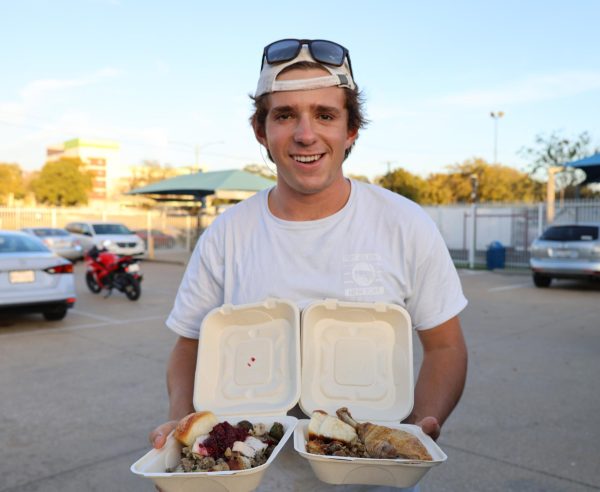
A few blocks down Cadiz Street, just south of the Main Street District in downtown Dallas, Froeb and his team took his mission on the road: bringing hot Thanksgiving dishes to those living on the streets.
“This is so fun,” Froeb said. “I enjoy this so much more than just dropping [food] off at a gate.”
However, this isn’t the first time Froeb has stepped up to help his community. As a San Francisco native, where the homeless population is more than 8,000, he grew up watching his church open its chapel at night to give unhoused residents a safe place to sleep.
Froeb and his family have always loved to cook, so preparing meals for those guests became both a way to serve others and a way to connect with their church community, he said.
Froeb’s passion for cooking began as a way for his mom to help him manage his ADHD. Now, he’s turned it into a business. Froeb’s freshman year roommate, Marcus Chen, recalls him killing the power in their Virginia-Snider dorm over five times after turning it into his makeshift kitchen.
“The place should’ve burnt down,” Chen said.
Froeb has continued this commitment in Dallas. Once a month, Froeb cooked Sicilian-style pizzas for guests at The Bridge Homeless Recovery Center. However, after a change in leadership, the effort had to be converted into an official, regulated service, making it difficult for them to continue doing it with the same ease and frequency.
The most important thing about a good, home-cooked meal is that it brings people together, according to Froeb. That’s also why he was determined to get meals out to those who need them most. He believes food is more than nourishment: it’s a shared experience, something universal that creates connection even among strangers. For those living on the streets, a single plate can offer not just comfort, but a moment of community.
“I mean, look at these people. They’re bonding over a meal, a plate of food that was given out by strangers,” Froeb said. “Everybody has to eat.”
Froeb’s Public Relations Manager, Ali Aga, tagged along to pass out meals with him.
“Luke has always hyped up the fact that feeding the homeless is something that brings him the greatest joy,” Aga said.
Although things took quite a turn when Dallas City Code Compliance officers began to follow Froeb’s truck. Giving food itself isn’t illegal, but how it’s done can violate local regulations. Many cities, including Dallas, have laws that regulate “food sharing” or “food distribution” in public spaces.
Dallas has strict requirements for anyone distributing food to people experiencing homelessness. To legally serve meals, Froeb would have needed to register his business with the city, prepare the food in a licensed kitchen and follow the official notification and safety guidelines required for public food distribution.
“They wanted to see that we weren’t basically trying to poison homeless people. I think that is what it came down to,” Froeb said.
Fortunately for Froeb, the officer didn’t issue a citation, but a warning and a “have a good day.”
“I have seen Luke cook in a kitchen and he loves what he does, but I’ve never seen him truly light up like this,” Aga said.