

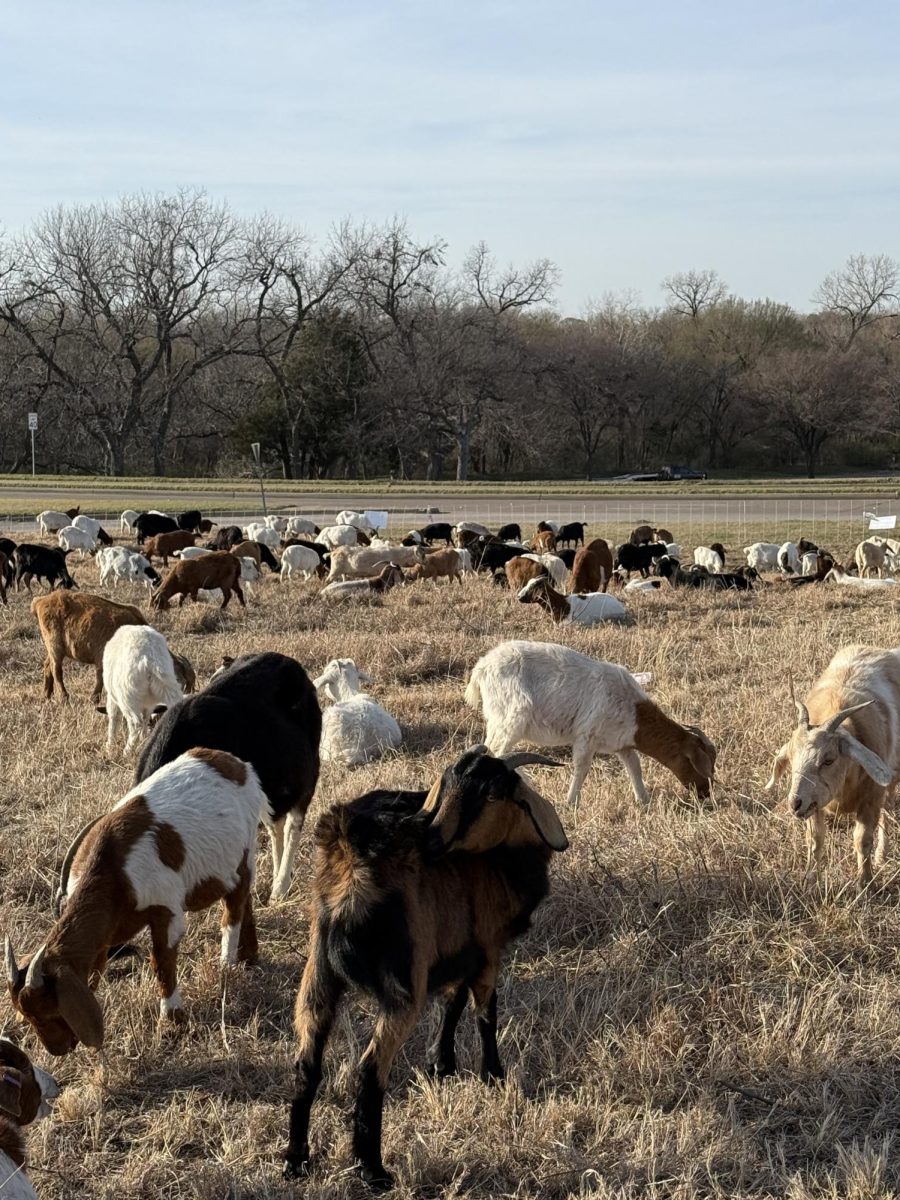
At White Rock Lake, not too far from the paths usually filled with cyclists and dogs on leashes, a herd of multi-colored goats gathers in a fenced field near the Bath House Cultural Center.Their heads are lowered with purpose as they chew through thick brush. Hooves press gently on the dry ground as they move across the land, disrupting the daily routine for the Lake Highlands neighborhood. A small crowd begins to form outside the fence, families and locals gather to watch Dallas’ newest environmental employees at work.
These goat landscapers graze over the new area, tearing through weeds and invasive plants that would usually require loud machinery to remove. Instead of the growl of a lawn mower, the goats work in silence with the occasional bleat. Children laugh, and residents chat outside the gate; the herd makes onlookers pause to watch their methodical chewing.
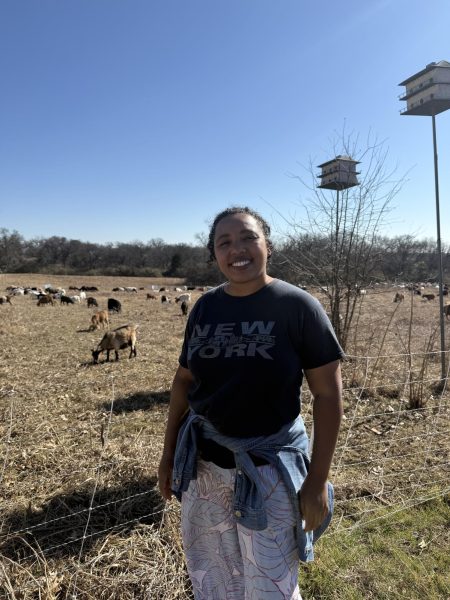
Many neighbors, like Zeni Demissie, say the goats go further than an environmental project, creating a sense of connection.
“This is such a smart investment by the city,” Demissie said. “It brings people together and just feels joyful to watch.”
Neighbors linger along the fence, leaning in to get a closer look at the herd. Children giggle as the goats interact with one another, while adults quietly point out the animals’ different colors and sizes. Phones click and videos roll as cyclists and walkers slow to watch, making it clear this has become a must-see attraction.
The goats aren’t just a curious spectacle for neighbors — they’re part of a deliberate environmental effort. Hired by the City of Dallas Parks and Recreation, the herd of more than 200 grazes on 11.5 acres of invasive plants like privet, clearing brush naturally without the disruption and expense of unnecessary fossil fuels. Constantly guided by a shepherd that rotates the herd through different fenced sections, the goats help restore the ecosystem by opening up undergrowth, cycling nutrients and reducing fire risk, all while giving local residents a rare chance to watch a sustainable “goatscaping” project in action
Open Space is a North Texas land management company that was in charge of this White Rock initiative starting in February leading into the early Spring months. Their Project Shepard specializes in environmentally friendly vegetation clearing using goats and sheep instead of heavy machinery.
According to Quincy Crow, the President of Project Shepard, goats are more effective and budget-friendly at removing invasive plants and dense underbrush that can be difficult or dangerous for maintenance crews to reach. The impact the animals make on the land is natural, and their trampling and waste byproducts help to promote growth while eradicating noxious weeds.
“I do love the sustainability of it; the reality is these areas cannot be remedied any other way,” Crow said. “The impact the goats have on the land is unlike anything that can be done mechanically.”
The public interest has been overwhelming for Crow. What began as a practical solution for land management, has turned into an outpour of community and symbolizes something bigger than just landscaping.
“With all of these pressures we have today, Project Shepherd is my pushback on all the craziness of this world,” Crow said. “Being able to be present, without technology, watching such a basic action of animals eating vegetation in nature with other people is such a beautiful moment.”
Some visitors travel specifically to watch the herd at work, drawn by curiosity and a love of the outdoors. Dianne Rottler, who came to see the goats after reading about them in the local newspaper said the experience lived up to her expectations.
“It’s every bit as perfect as I thought it would be,” Rottler said. “No mowing sounds, just the goats quietly munching away. Fields like this are meant to be open prairies, and this is such a smart, natural way to care for the land.”
Her visit highlights how the project not only restores the environment but also brings people together, leaving neighbors and newcomers alike with a small moment of joy and connection.
“I think this is such a beautiful way to bring people together, especially in such divisive times,” Rottler said.