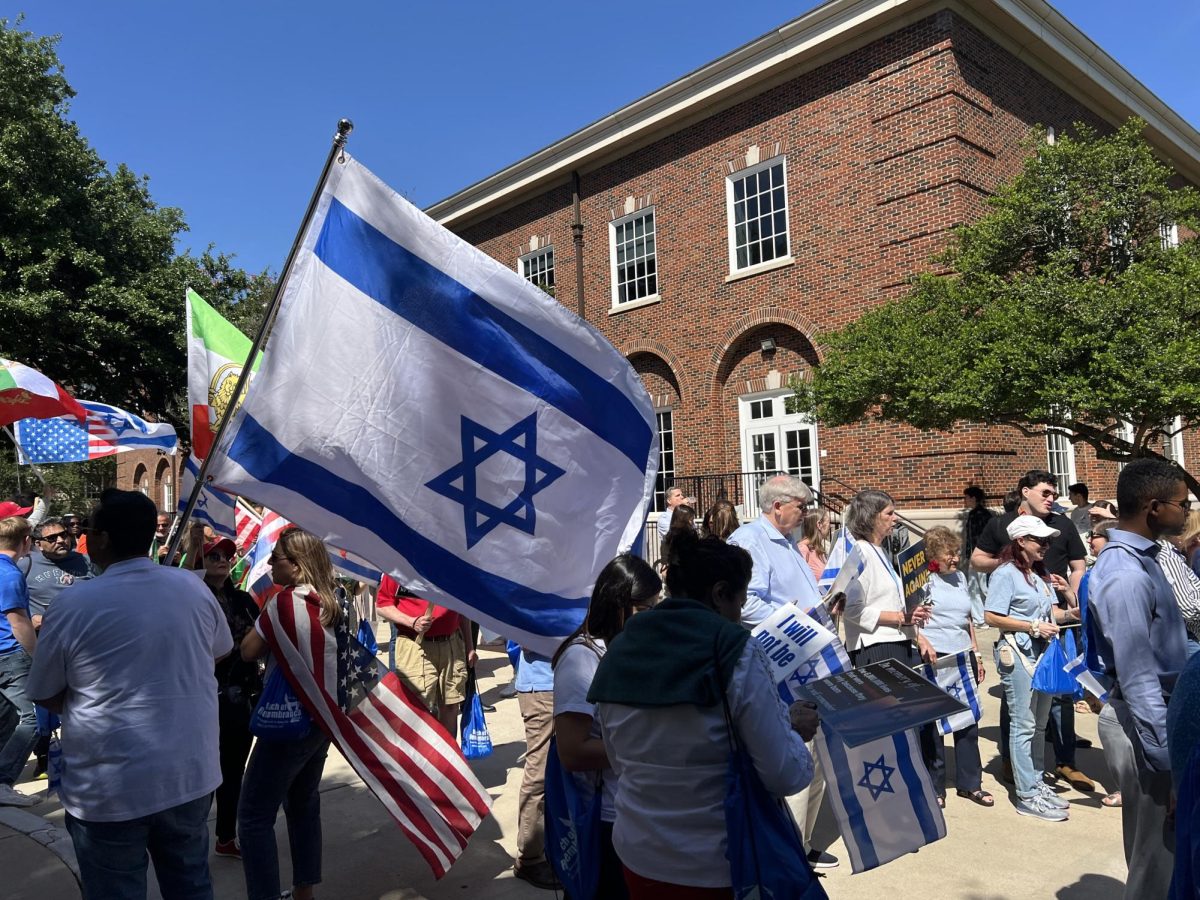



A crowd gathered and marched through Southern Methodist University’s campus on April 19, holding flags and signs to celebrate what is known as The March of Remembrance.
The 5th annual march brought together students from the Jewish student organizations on campus, like Hillel and Chabad, as well as members from Christian communities, to not only honor victims and celebrate survivors of the Holocaust, but to publicly stand against antisemitism during the season of Yom HaShoah, the Jewish day of Holocaust remembrance.
The event on campus was a collaboration between March of Remembrance executive director Victoria Sarvadi, Th.D., and co-director Rabbi Heidi Coretz, who is also the director of Hillel at SMU.
“Today was again a solidarity effort between the Jewish and the Christian community to come together to remember the victims of the Holocaust and to vow to never again stay silent,” Sarvadi said.
This year’s program included the award distribution to students who submitted poems and essays in line with the event’s theme, “building bridges and allies.” As well as prayers and the lighting of seven candles in memory of the six million Jews and other victims of the Holocaust. Participants then moved outdoors for a march around campus carrying signs as a visible stand against modern antisemitism.
Ali Vogel, the director of student Jewish Life for Hillel at SMU, commented on the importance of the march.
“We not only remember, we want to also make the statement that we have to take action, we have to take a stand, we have to become upstanders,” Vogel said. “It’s not only the perpetrator, it’s also the people who stay silent and are bystanders.”
The program concluded with a solemn memorial ceremony in which the names of Holocaust victims were read, and stones were placed on a tombstone in accordance with Jewish tradition, followed by a reception.
During the march itself, various participants were seen waving Israeli, American and even Iranian flags. Members of the Iranian-American community came out in strong support of the cause, demonstrating unity.
Shervin, an attendee who declined to give their last name, explained their presence there.
“We are Iranian, and right now we have a war between the U.S., Israel and Iran, and we want to get the regime changed completely,” Shervin said. “We are supporting the conference and supporting the Jewish people.”
Michelle Nazari and her Iranian-American husband, Shahin Nazari, shared this sentiment as they came out to support the march.
“We, as Iranian-Americans, wanted to come and support the people of Israel, and remember [those] who have already been killed, and say with them, ‘never again,’ for the Jews, and also the Iranian people,” Michelle said.
The couple and other members of the Iranian-American community learned of the gathering through a WhatsApp group and saw an opportunity to affirm mutual support amidst shared struggles against oppression.
“We wanted to tell them that we know their pain. We went through this same kind of pain, and we are here to stand with them because they stand with us,” Shahin said.
The gathering took place amidst a backdrop of global political tension, with the recent U.S. and Israeli military actions in Iran that have created a ripple effect of strife and energized movement across the diaspora groups of all affected parties. Earlier this year, SMU’s own Association of Iranian Students held vigils and flag installations on campus to memorialize the protestors killed by the Iranian regime.
Organizers noted that the Iranian turnout, while an unexpected surprise for them, was a welcome one that illustrated the event’s power to forge unlikely alliances.
“I was surprised, they haven’t been here before,” Sarvadi said. “The compassion and the fervor that they share— I talked to a couple of them when we were going through the march, and they have just such strong conviction and love toward Israel.”
SMU junior Jonathan Kalach Chelminsky, a Hillel member, found importance in learning from past generations and cherishing unity.
“It’s important for us to listen to speakers, listen to different types of stories and different points of view, and keep the history rolling [by] saying it,” Kalach Chelminsky said.
With the student involvement and interfaith participation, Vogel believes that the March of Remembrance is one example of many that helps the Jewish community feel welcomed and thrive on SMU campus.
“We feel… very supported by SMU, and it’s an honor to be part, not only of the Jewish life but a part of SMU because it’s a unique university that allows us to live our Jewishness,” Vogel said.
Chloe Casdorph contributed to the reporting of this story.