

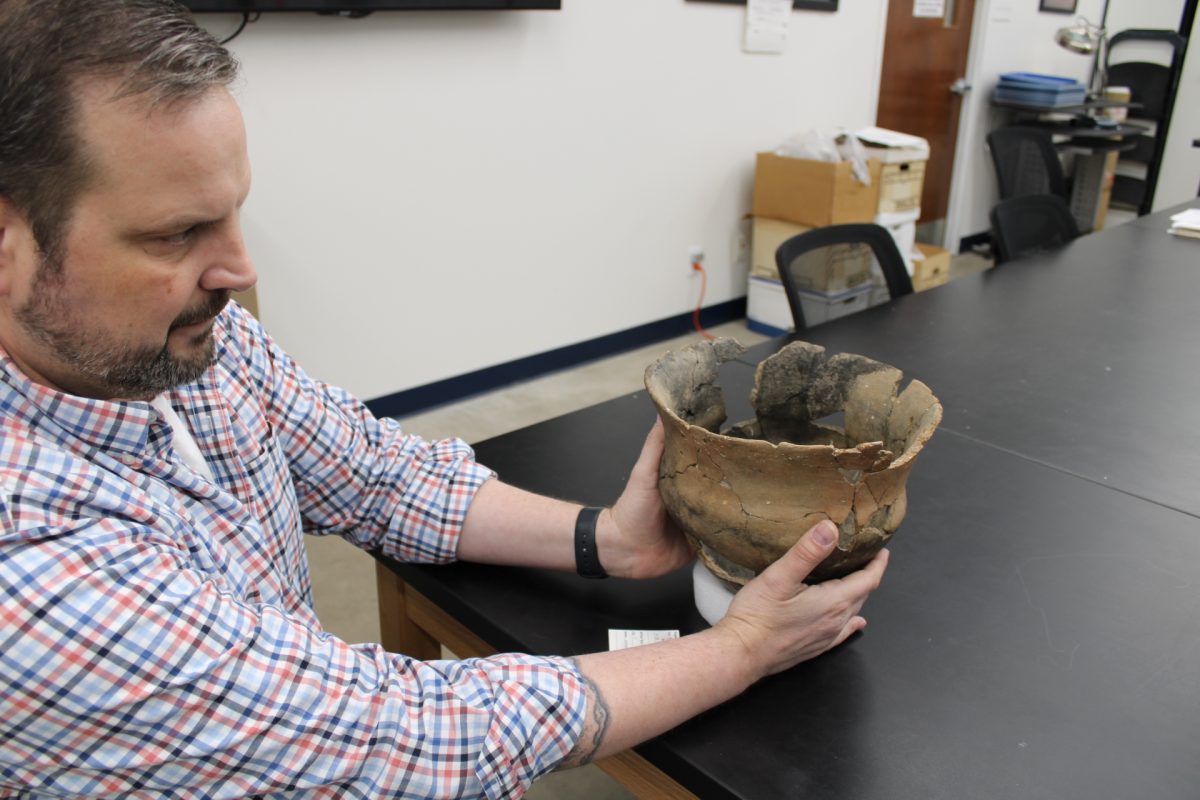
Located in the basement of Heroy Hall at SMU, under fluorescent lights in the Archeology Research Collection, lies a treasure trove of North Texas and international history spanning centuries.
Artifacts line cabinets and shelves surrounding the lab. From arrowheads once used by Native American tribes to ancient Greek coins minted in 247 B.C.E., found in Egypt during a survey in the 1960s. Each artifact and document in the collection tells the story of past human experiences.
“It’s about the closest thing we have to literal treasure,” said Matthew Boulanger, Ph.D., director of the Archaeology Research Collections at SMU, pointing to the group of bagged coins on the table. “These were all from an oasis in the Sahara. You can imagine people as they’re traversing, bringing their wares, they stop off in this oasis and set up like a shop for people passing by.”
Boulanger walks over to the brown cardboard boxes neatly stacked against the wall. He takes off the top and pulls out a plastic bag full of gravel made from charcoal and petrified wood.
Due to space constraints and red tape with the gravel belonging to a state-sanctioned collection, Boulanger wishes to discard or deaccession the gravel while retaining a small sample. He is unable to do so for any other item until the effort of identifying everything in the collection is complete.
“I haven’t actually deaccessioned anything because, going back to where we started, we don’t even know what we have,” Boulanger said.
The ARC lab has been working to identify, preserve and digitally document around 4,000 boxes of historic artifacts and documents that sat neglected in Heroy for three decades. While carefully following state and federal guidelines, the lab faces a process that will take two decades. For Boulanger, this isn’t just about preservation— it’s about ensuring the public’s history is accessible to the community for generations of study and discovery.
Boulanger has taught at SMU since 2016 as a permanent lecturer in the archaeology department, but became the director of the ARC in 2022. The previous director, Sunday Eiselt, who led significant public awareness and fundraising efforts, left SMU to work with a Native tribe in Arizona.
“I wanted to continue the work that she’s doing, but go in a slightly different direction. One of those directions is a lot more involvement with the department and with the public,” Boulanger said.
In the work that he’s doing to preserve Texas history, making it accessible to the public is paramount. He hosts an open lab one Saturday a month, allowing students and local researchers the chance to work with the collection. 3D scans of artifacts have been posted online for anyone to access worldwide. He’s even created an educational traveling trunk for local schools to use.
“It’s one thing to talk about archaeology, but it’s another thing to give somebody a real artifact,” Boulanger said. “We have up in the attic, hand axes from Africa that were made half a million years ago. So allowing a student or somebody to hold that, they’re literally touching humanity’s past.”
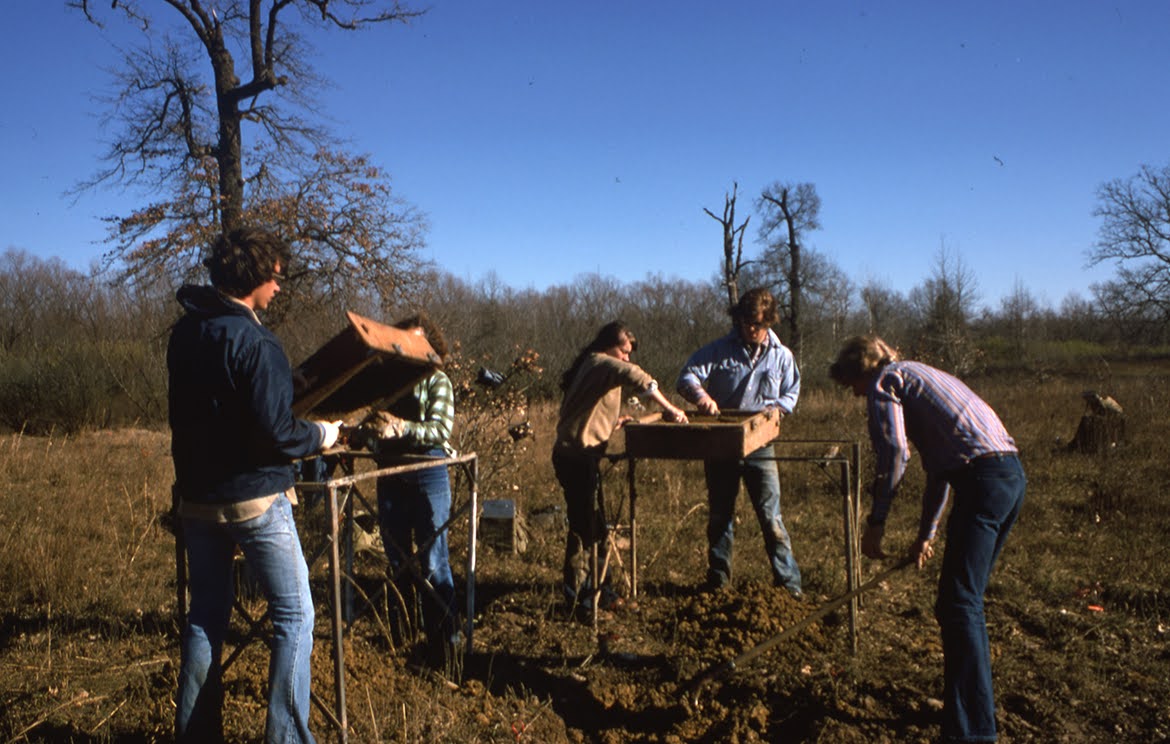
Most of the ARC’s collections were generated between 1965 and 1993, from various archaeology projects SMU conducted for federal and state agencies. Many of the artifacts and documents were found during the “wild west” era, as Boulanger calls it, in the 1940s through the 1960s, when anyone could conduct digs without training and artifacts lacked proper documentation and preservation.
The combination of lax standards, later changed by government regulations in the 1970s, and the three decades the collection sat in neglect has caused the backlog the lab faces.
“Because of a long period of neglect and not some great practices by the folks that should have been doing the things in the 70s, 80s, we’re stuck with just trying to get a handle on what we have,” Boulanger said.
Boulanger compares the research collection to a special collections library, one in which each book is rare, but nothing is cataloged. Like a library, the ARC can loan collections to other universities. While reviewing old documents, he and postdoctoral research fellow, Kelton Sheridan, discovered that two of SMU’s research collections had been on loan to The University of Texas at Austin since 1983.
“It’s a bit like if I checked out… “Clifford the Big Red Dog” from my library as a kid, and I’ve been holding onto it since 1983,” Boulanger said.
The two collections are from the Toledo Bend Reservoir in East Texas along the Louisiana Border and Lake Palestine, which is 10 miles southwest of Tyler, Texas. UT packed up the collections in April, and the ARC is arranging its return to campus after the spring semester ends.
“We’re excited to have these returned to SMU. None of them have been thoroughly studied since the fieldwork took place in the late 1960s, and they should provide some great research opportunities for SMU students,” Boulanger wrote in a follow-up email.
SMU historically has not provided the program with funding, which leaves the ARC to fundraise and seek grants. Boulanger is thankful for the overhead and facilities that SMU provides to house the collection, as well as the effort to employ student research assistants, like sophomore Linda Benites.
“Dr. Boulanger, he’s super funny, super personable,” Benites said. “He really treats us not just as his employees but as students. It’s really nice to see a mentor be super nice.”
Benites, now in her second semester in the ARC, finds the grunt work tedious at times, but is thankful to see archaeology through a new lens.
“It definitely broadens your perspective and scope of the whole subject of anthropology and archaeology,” Benites said. “I also really enjoy seeing all of the pictures and documentation they have of people actually doing the excavation.”
Paulina Olvera, a fellow research assistant and sophomore, unexpectedly came across artifacts that connected her to her home, vases from Paquimé, a cultural site in the Northern Mexican state of Chihuahua, where she’s from.
“I’m from the northern part of Mexico, so a lot of the things, like those vases, I’m familiar with,” Olvera said. “I learned about it in school, so I think it’s really interesting to get to see them in real life.”
Olvera believes that people should take the time to learn about the history of where they’re from to have pride in their backgrounds. The lab’s collection may help them discover hidden personal history.
“This lab is really underground. Not a lot of people know about it,” Olvera said. “People should learn more about their history from where they’re from. Be more cultured. Knowing about where you’re from makes you feel more proud.”
Steve Denson, assistant dean of student success at Cox School of Business, has been searching for pieces of his Chickasaw Nation ancestry on auction websites to repatriate them back to where they belong. When he came across an 800-year-old Mississippian bowl for sale, he started the process to do just that.
“It’s no one person’s right to own that bowl,” Denson said. “That bowl is going into a museum with a lot of other artifacts that were made by the same people at the same time.”
Denson brought the bowl to the ARC for them to authenticate its origin and safely store it until Chickasaw Nation representatives retrieved the bowl in November 2025.
“I wanted it authenticated and I wanted it well preserved,” Denson said. “They were wonderful to do that for me. They are always looking for ways to collaborate with tribal nations as well as all cultures.”
Denson sees these efforts as a way to give back to the tribe that has cared for him.
“The tribe is your family; they take care of you, you honor them. Making sure people know we’re still living, thriving people, rather than just museum pieces,” Denson said.
This wasn’t Denson’s first time working with the ARC. In 2015, a leak in the lab’s attic repository of Heroy revealed the remains of hundreds of Native American individuals. Under the Native American Graves Protection Act, those remains are to be repatriated to the tribes they belong to, and Denson worked with the lab for several years to guide the process.
“We started holding these meetings and bringing people in, and talking to them about ‘Do you have a repository that you can take this. If not, shall we keep them but preserve them in a respectful manner until your tribe is ready to take these remains,’” Denson said. “The tribes went with that.”
Over the years, Denson has found an unlikely friendship and trust in archaeologists, seeing how the ethics of the field have changed to put tribal communities first.
“When I found out their ethics, their care and making sure they aren’t doing anything that’s contrary to tribal intent, they won me over,” Denson said. “Now they’re some of my best friends.”
The repatriation efforts and opportunities to collaborate with indigenous communities drew Kelton Sheridan to SMU’s ARC as a post-doctoral research fellow in August 2025 from UT Austin. She says community work is the single most important aspect of doing archaeology.
“The future of archaeology is definitely community-based,” Sheridan said. “We should not be doing work on anyone’s histories or heritage without consulting, and not just consulting but collaborating with them on that work.”
From Sheridan’s doctoral dissertation, conducting archaeological field work with a mission in San Antonio and working with descendants, her goal has been to preserve history as a historical archaeologist. She feels the ARC has been moving towards community-based archaeology.
“Dr. Boulanger was doing that before I arrived, so it’s nice we’re aligned in that,” Sheridan said.
Part of changing the culture is working with the next generation. Alongside Boulanger, Sheridan guides the student researchers and feels that mentoring is one of her favorite aspects in her role at SMU.
“It makes me hopeful for the next generation of archaeologists because I think we are a discipline that is only going to improve,” Sheridan said.
The effort to identify and document everything, Boulanger estimates, will take 20 to 25 years, spanning the rest of his career, but will ensure that future generations have access to conduct innovative research.
“What I hope happens is that once we’re finished with all of the inventory work, that it’s suddenly available for people to ask new questions about,” Boulanger said. “The reality is that inventory work is never done.”
Despite the uphill battle, Boulanger and the lab have still been able to do important work in repatriating artifacts to Native tribes and conducting research. The lab may also have a hand in discovering if human DNA can be extracted from a pair of 5,000-year-old sandals found in the attic repository, wrapped in toilet paper.
Boulanger reached some colleagues who were willing to test them in Denmark. According to them, if the DNA is extracted, it would be the first time that has been done.
“When [the sandals] came to SMU in 1966, DNA extraction from them was not even possible,” Boulanger said. “But they’re here today and potentially, we could do that.”
Boulanger sees this pursuit of discovery and learning in archaeology as the main use of the ARC.
“For me, the real joy is in finding something out about the world. The real joy is in the discovery and the scientific process,” Boulanger said.
New questions of what could be done when the Archaeology Research Collection is in a sustainable condition, by future researchers, may unlock new scientific advances on how human history and archaeology can be studied.
“All it takes is one student or faculty member to say, ‘I wonder if you could do this with these collections.’ And who knows?” Boulanger said.
Editor’s Note: This story has been updated to correct an earlier reference to 4,000 artifacts; the collection contains 4,000 boxes of artifacts.