

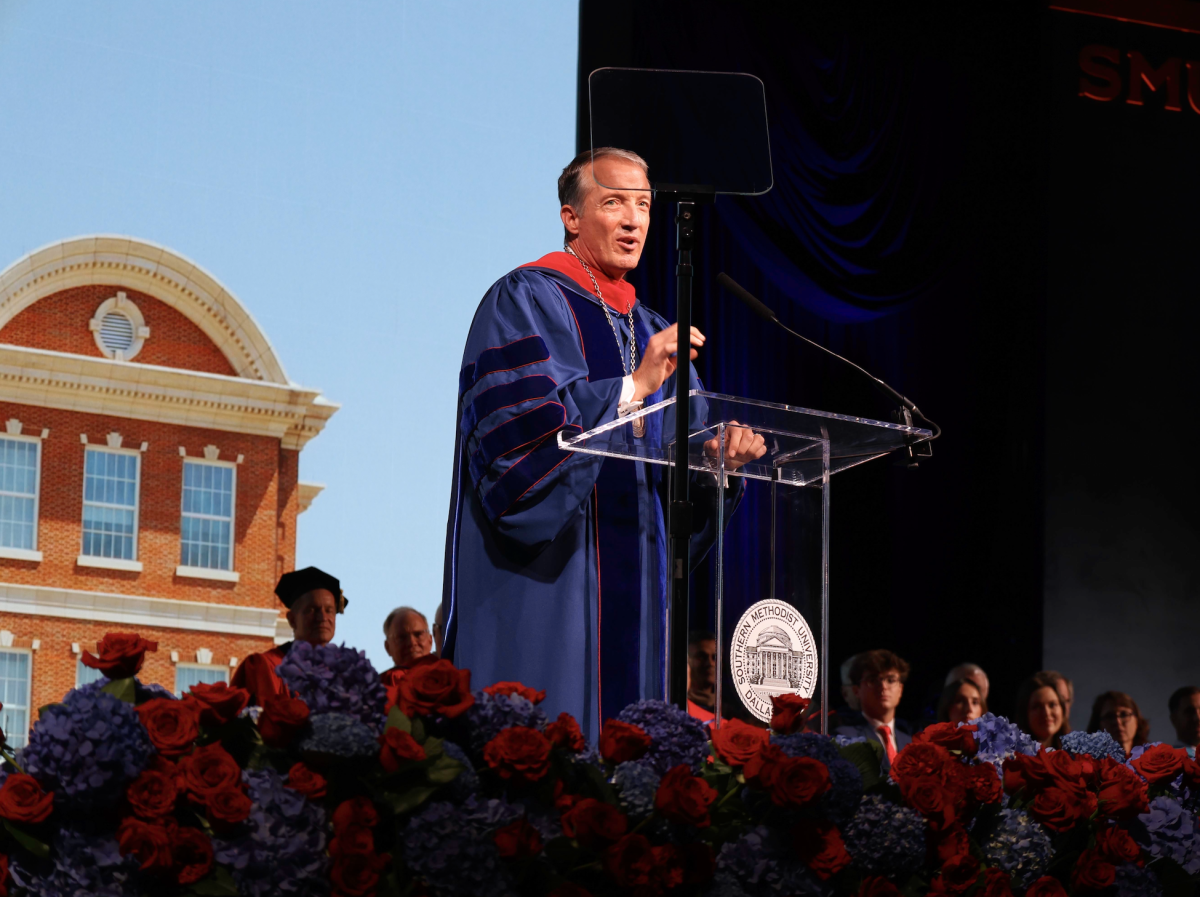
It’s late December in Dallas, and the trees surrounding University Park have finally changed to their autumn hue. SMU’s 11th president, Dr. Jay Hartzell, didn’t follow this fashion. Instead, he took initiative early.
During his first week on the job, in June 2025, President Hartzell met with the O’Donnell Foundation for the first time and began exploring the ideas of an energy studies program and academic honors fund.
On July 3, he announced the updated academic calendar, allowing students an extra day of Thanksgiving break and keeping university resources available to students until Thanksgiving Day.
Two weeks into the fall semester, President Hartzell announced that second-year students are no longer required to live on campus. This decision sought to make room for the growing freshman classes, while providing second-year students with more housing options.
“We’ve gotten a lot of feedback that many students would like some choices,” Hartzell said. “We still want this to feel like a residential college experience. I think this is a way, at least for a while, to offer some more flexibility and accommodate the growth we’ve been experiencing.”
Following his inauguration on Sept. 12, Hartzell invited the SMU community to participate in the Strategic Planning Survey to gain first-hand perspectives on SMU’s academics, research and athletics. The responses were and will continue to be utilized in discussions for planning the university’s future.
“When you think about what you’re trying to do, you’re trying to make sure that the campus as a whole is the one shaping the plan,” Hartzell said. “It’s not just the leadership team, the faculty or any smaller group driving it.”
The Strategic Planning Survey categorizes common themes and threads, which are then addressed with their respective college or department. For example, Provost Rachel Mersey recently met with the academic affairs team to discuss matters that arose from the survey.
After the Strategic Planning Survey’s initial email on Sept. 24, Hartzell and his communication team sent reminders to the community on Oct. 3, 9 and 15 to get as much information and as many perspectives as possible.
On Dec. 7, The Dallas Morning News reported that the O’Donnell Foundation invested $60 million into launching an energy studies program and an academic honors fund at SMU.
“Energy is clearly important. It’s something you can imagine the university working on for decades to come,” Hartzell said. “Everything from solar, nuclear, wind, oil, gas, all of it.”
Hartzell noted the importance of collaboration in this initiative, not only among the SMU administration and the O’Donnell Foundation, but among various academic sectors at the university. The crossover hopes to bring future students to SMU.
“I love that it brings together different schools in the college,” Hartzell said. “I think it’s a way for us to get, hopefully, 20 to 50 students a year who might have picked somebody else to pick us.”
This era of SMU brings a theme of growth and finding out what’s best for the community through extensive research and student perspectives.
After The Daily Campus published an article in December regarding the law school move, Hartzell noted that there are many ways to develop and support graduate programs.
“The law school is an important part of campus, is part of how we’re known and is in many ways thriving in today’s environment,” Hartzell said. “The facility is not at the level it could be or should be for that kind of school.”
There are many factors at play with this decision-making, such as considering retrofitting the existing building or building something new. Hartzell and the SMU administration will fundraise to make this project happen, but first, they will continue to have conversations to determine what works best for SMU.
The renderings The Daily Campus previously published are not final and reflect early concepts of the project. This project includes potential graduate housing, which could reduce the need for graduate students to find off-campus housing and transportation to campus.
“When it [graduate housing] goes well and goes right, it’s cool because you get students from all parts of the country or world, who are studying all kinds of things, and now they’re hanging out,” Hartzell said.
Hartzell and the SMU administration are discussing possibilities and will develop a concrete plan over time with fundraising and research. When dealing with backlash from certain decision-making, Hartzell quoted a mentor of his.
“‘If nobody’s upset, it wasn’t really a decision,’” Hartzell said. “We want the law school to be great, we’re just quibbling over how to do it. It’s just a debate about how to accomplish it.”
Hartzell, along with the SMU administration, has goals to build on what is already great about the university.
“Our goals are to attract more talent and get star students and faculty to say yes to us,” Hartzell said. “We want to provide new opportunities for the job market or graduate school for students. You can go down that list and take advantage of our unique opportunities.”
Editor’s Note: This interview was conducted in December 2025 and published in January after The Daily Campus’ winter hiatus.