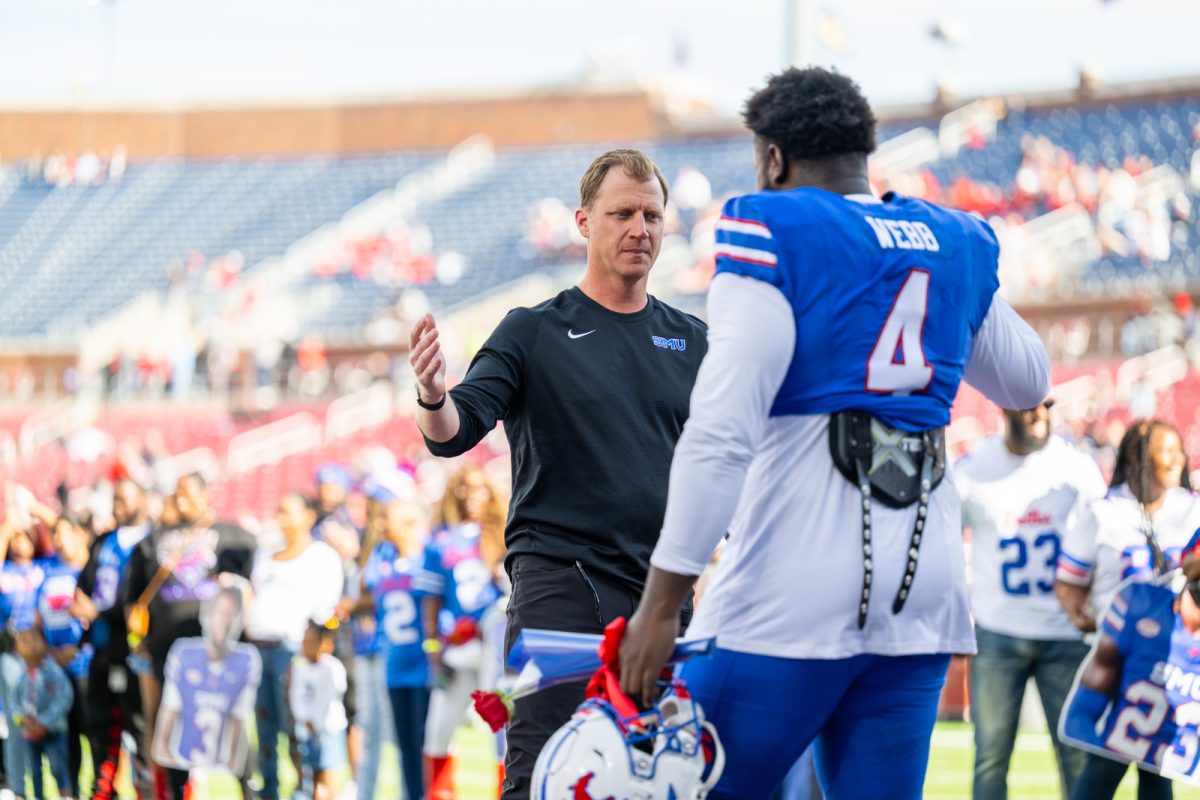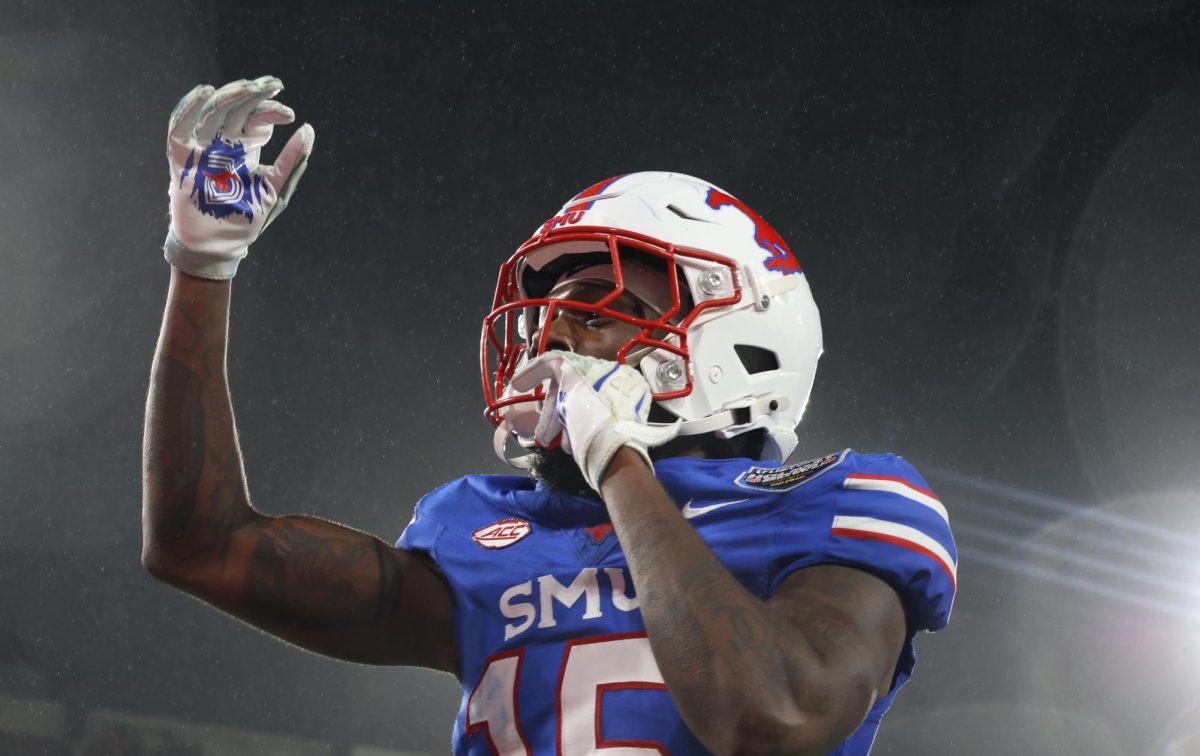



Smoke swirls in the tunnel as cleats echo off the concrete. One by one, the SMU players emerge beneath the floodlights, faces steeled, hearts pounding. The stage is set for Louisville, as SMU’s home battle of the season is soon to begin.
In a college football landscape once defined by rigid rules and restricted movement, the emergence of name, image and likeness (NIL) rights and the transfer portal has ushered in a chaotic new era. With over 2,400 players entering the transfer portal this year alone—more than the past five years combined—the sport is undergoing seismic shifts. What was once a structured path for student-athletes has become a marketplace of money, mobility and mounting uncertainty.
To better understand the current state of NCAA football, three Southern Methodist University football players offered a candid glimpse of their experience with the transfer portal and how these changes affect student-athletes on and off the field. For many athletes, the 2021 NIL rule change has been a game-changer, providing financial security and control over their careers like never before. NIL allows college athletes to profit from endorsements, sponsorships and personal branding opportunities while maintaining their eligibility.
Offensive lineman Addison Nichols previously played for both the University of Tennessee and the University of Arkansas before transferring to SMU for his redshirt junior season.
“It [NIL] gives student athletes a great opportunity to capitalize on whatever sport they’re in,” Nichols said. “They’re able to create a safety net for life. If they are smart with what they earn, they’re walking into life with a great start.”
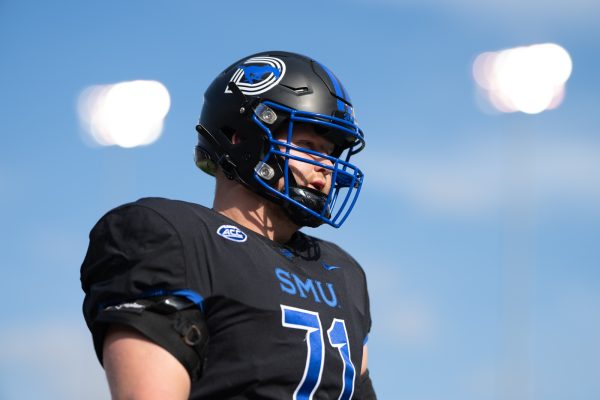
Offensive lineman Logan Parr transferred to SMU for the 2023 season after two years at the University of Texas and is currently in his sixth and final season. Parr echoed Nichols’ sentiment.
“People are making millions of dollars,” Parr said. “If you’re chasing money, there’s no point in staying at a smaller school to develop. You can make life-changing money in college now.”
However, the NIL landscape isn’t just about top-tier players cashing in.
According to Parr, NIL compensation varies widely across programs and positions, but most athletes still lack the tools to evaluate their worth accurately.
“Some players overvalue themselves, others undervalue themselves,” Parr said. “Either way, without clarity, it’s hard to make smart decisions at 18 or 19 years old.”
With increased freedom comes increased risk. Many players enter the transfer portal with hopes of securing a better opportunity or a more lucrative NIL deal, only to find themselves left without a team.
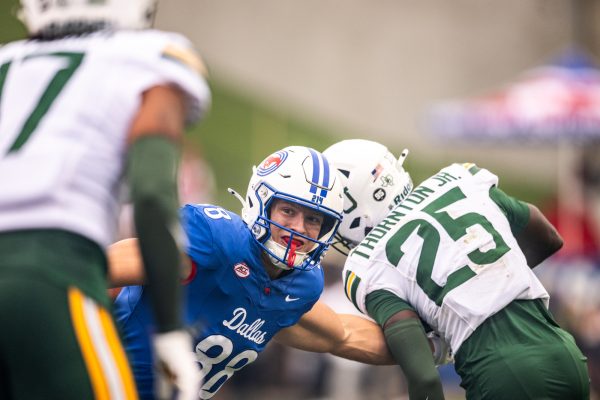
Tight end Matthew Hibner transferred to SMU for the fall 2024 season after completing his degree at the University of Michigan. Hibner added thoughts on the current state of the transfer portal and NIL.
“All these players who hope to find opportunity elsewhere leave the situation they were in and then just kind of get caught in the middle of nowhere,” Hibner said. “There are only so many scholarships, only so much NIL money.”
Even when players land on their feet, frequent transferring can come at an academic cost.
“There’s going to be a huge decline of college graduates in revenue-generating sports,” Parr warned. “It’s hard to transfer credits from school to school, and it’s going to need to be addressed—maybe with a contract system or academic regulation.”
The lack of uniform regulation is a major concern among players. Collectives, boosters and NIL agents operate without much oversight, often giving richer schools a considerable advantage.
“It’s the Wild West,” Nichols said bluntly. “If it keeps going this way, it’ll collapse. There needs to be structure.”
Hibner added that the advantage often falls to schools with more resources.
“Right now, the NCAA needs to introduce norms to make sure the system stays fair,” Hibner said. “Big-resource schools have a huge advantage over smaller programs.”
The three players disagreed on whether NIL has created more parity in college football. Parr argued that the gap between big and small programs has only widened, while Nichols noted that any school, if it has the money, can get anyone.
“Success is more accessible now,” Nichols argued. “It’s not just the SEC powerhouses.”
While all three players agreed that some form of regulation is necessary, Parr suggested that “revenue-generating athletes should fall under different rules than non-revenue sports,” and supported a policy allowing athletes to transfer once before graduation, with more freedom after earning their degree.
Legal changes may be on the way. In House v. NCAA, the parties have negotiated a settlement that created new revenue-sharing rules among athletes. The House v. NCAA settlement, approved June 6, 2025, ends the NCAA’s amateurism restrictions by approving a $2.8 billion payout to former Division I athletes and allowing schools to pay current students directly under a revenue‑sharing model capped initially at $20.5 million per school.
Hibner explained that under the current terms, schools are limited to distributing roughly $22 million in NIL revenue annually, with most of it going to football and basketball players. The bigger issue is how to value athletes fairly across different sports.
“The question is, how do you calculate intrinsic value versus just revenue gain?” Parr said. “All sports matter to a university’s reputation, even if they don’t make as much money.”
Meanwhile, compliance agencies like Deloitte are preparing to vet deals to ensure they’re legitimate and within limits.
“It’s going to get worse before it gets better,” Parr warned. “There’s going to be violations and hiccups as people test the waters.”
Despite the allure of NIL, all three players emphasized that money wasn’t the top factor in their transfer decisions.
Parr prioritized the opportunity to play and the quality of the school.
“The NIL was a factor, sure,” Parr said. “But it wasn’t in my top three. I wanted coaching, culture and a chance to contribute.” Hibner also valued similar factors in his decision.
“When I transferred, it wasn’t about money. It was about finding a great business school, a supportive culture and coaches who actually cared,” Hibner added.
Each player praised SMU, not just for its athletic opportunities, but for its academic prestige, alumni network and tight-knit community in Dallas.
College football is in the midst of an identity crisis. While the ability to profit from NIL and move freely between schools empowers athletes, it brings confusion, instability and an increased risk of player exploitation.
“The line between amateur and professional has definitely been blurred,” Parr said. “Players need better guidance.”
As lawsuits move forward and new oversight mechanisms are introduced, all three players hope the system evolves without losing sight of education and long-term success.
“Yes, we’re athletes,” Hibner said. “But we’re students too, and if the system doesn’t ensure we get our degrees, then we’re just being used.”