

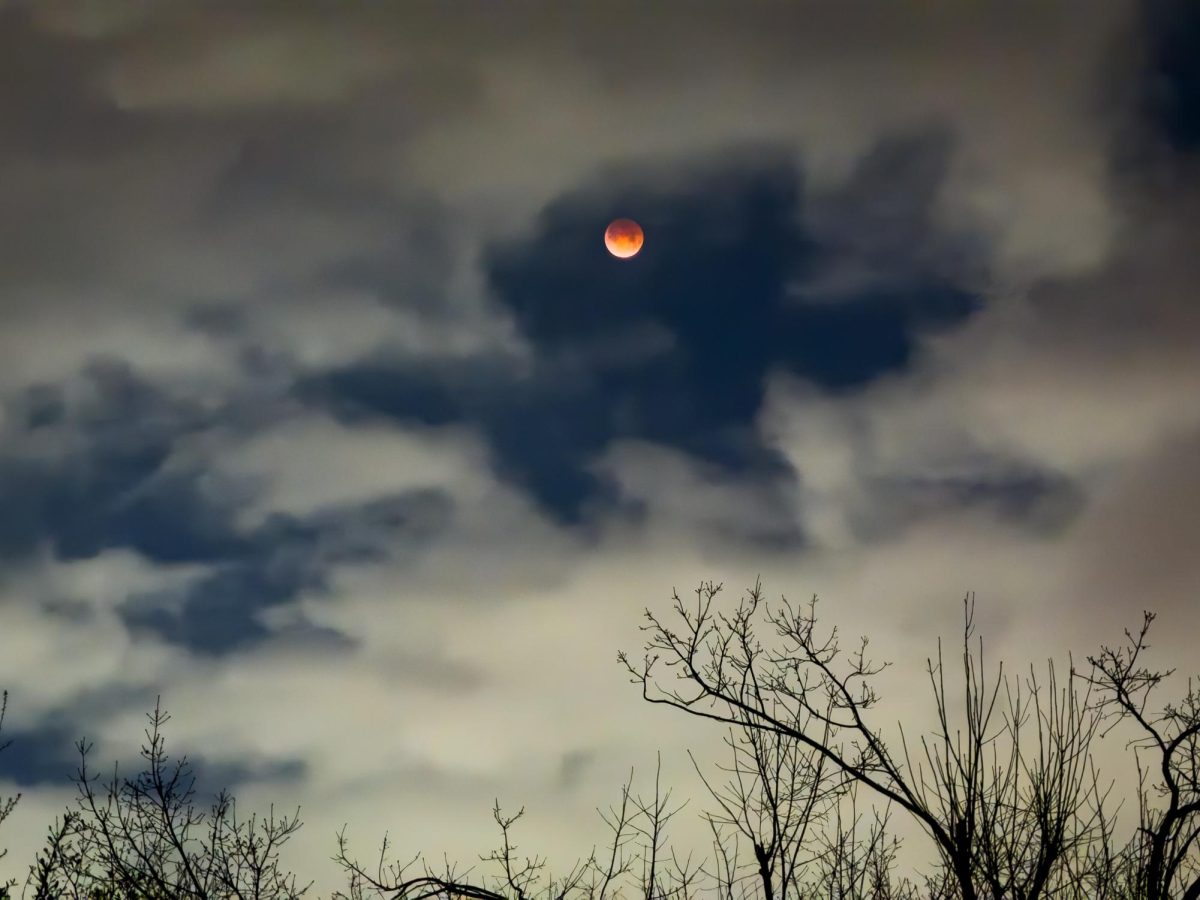
On the very, very early morning of March 3, a Lunar Eclipse occurred in the night sky, creating a faint red colored moon. But in Dallas, it could be seen for only a few split seconds if you were lucky enough to catch it through gaps in the clouds.
In Dallas, and more specifically at Southern Methodist University, visibility was limited to only a few fleeting moments through breaks in the clouds.
The phenomenon, often called a “blood moon,” occurs when the moon takes on a reddish tint from sunlight filtered through Earth’s atmosphere after the sun’s direct rays are blocked. The last time a Lunar eclipse was visible in Texas was not too long ago, on March 13 through 14 in 2025.
Totality began roughly from 5 a.m. to 6 a.m. CST, offering a view of a uniquely colored moon for those who glimpsed at it. Unlike a solar eclipse, in which the moon blocks the sun, a lunar eclipse happens when Earth passes between the sun and the moon, casting its shadow on the lunar surface.
Within Earth’s umbra, or dark central shadow, only faint reddish sunlight refracted around the planet’s edges reaches the moon. From the moon’s perspective, it would resemble a sunset ringing Earth’s horizon all around.
To be more specific about the color change, blue and violet have shorter wavelengths and scatter easily, so they are unable to reach the moon during a total lunar eclipse, whereas longer wavelengths like red and orange can.
The personal journey it took to take the photo was more “buck for the bang” in this instance. The sky that night was uncooperative with those curious and crazy enough to wake up at such an early hour to try to spot the lunar eclipse. Overcast all around, with only rare breaks for a clear view, making seeing the moon this night almost impossible, like trying to hope for a perfect match with poker cards.
To those who care to wonder how many times the moon was clearly visible within the hour of its totality at SMU, the answer is a frustrating two times. Catching it on camera, let alone seeing it in person, almost made it worth it, given the few opportunities under the cloudy circumstances.
If you slept through the night like any sane person, you might not have missed much. But if you’re curious to see it for yourself, the next total lunar eclipse visible in North Texas is June 26, 2029.