

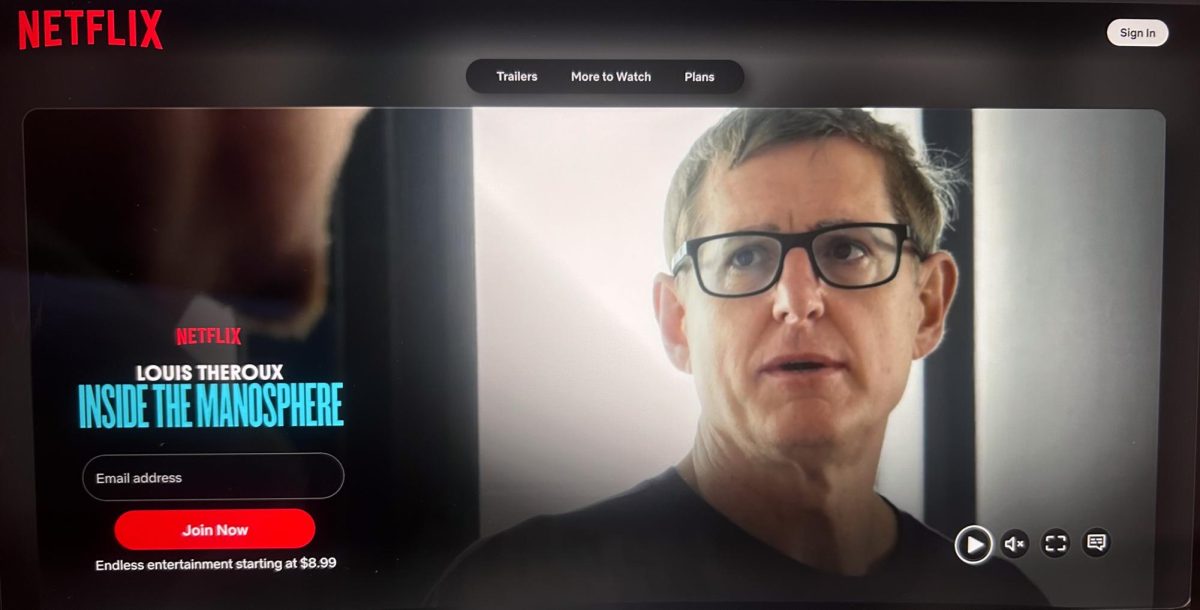
Released on March 11, “Louis Theroux: Inside the Manosphere” follows British journalist Louis Theroux as he travels to the United States and Europe to meet some of the internet’s most prominent manosphere influencers. The documentary reveals that while these men preach strength, truth and discipline, they build their brand on outrage, exploitation and insecurity.
The manosphere is a network of online communities centered on men’s issues that promotes misogyny, anti-feminism and extreme masculinity while presenting itself as self-improvement. Men in these spaces believe that modern society is producing weak men, mainstream institutions cannot be trusted and that men must reject “the matrix”—a catch-all term for the systems supposedly designed to hold them back. The manosphere’s idea of success hinges on wealth, dominance and control over women.
Theroux sets out to understand this world from the inside. The documentary begins with Harrison Sullivan, an influencer known for flaunting money, fitness and women. Much of his image is tied to how he makes his money. He runs a Telegram group where he gives his financial advice and promotes his trading firm, which has been labeled unauthorized by the UK Financial Conduct Authority. He also promotes adult content creators, even buying a company that manages them, yet in the film calls them “disgusting” and “repulsive.”
Interestingly, Sullivan openly admits that his content is shaped by the “attention economy,” and thus, he leans into controversy to grow his audience. At one point, when asked by Theroux if he has ever considered being a “good person” and encouraging his audience to make good choices, Sullivan shrugs off morality.
“If I’d just done good things, I would never have really blown up on social media in the first place,” Sullivan said in the documentary.
Later, we meet Justin Waller, a steel businessman from Baton Rouge who advises young men about women. While he promotes “traditional values,” his personal life tells a different story. He participates in one-sided monogamy, where he has multiple partners while the woman he calls his wife, though they are not actually married, stays faithful to him. Theroux also speaks with two of Waller’s fans, who express the belief that men have no inherent value and must earn it through suffering and success.
Amrou Fudl, known online as Myron Gaines, hosts the “Fresh & Fit” podcast, pushing even more extreme views. He claims that women are “subordinate” to men, arguing that they should not be able to vote or hold positions of authority. He believes these roles are what women truly want. His podcast revolves around dating, gender roles and masculinity. It has also drawn criticism for demeaning women and spreading misinformation.
Rather than aggressively confronting these views, Theroux takes a more measured approach. While Theroux challenges his subjects and is clearly critical—questioning their claims or pointing out inconsistencies—he largely allows them to speak freely. He asks simple questions in a mild manner, but the men become defensive fast. For instance, when asked what he means by “one-sided monogamy,” Waller claims that Theroux is “setting [him] up,” suggesting Theroux is upset, despite his calm composure. I find Theroux’s restraint effective—by giving the influencers space, Theroux lets their contradictions surface naturally, which likely reveals more than a direct confrontation would.
Theroux sets aside a few minutes of the documentary to explain why the manosphere’s extreme messages resonate. Many of the men featured describe unstable or abusive childhoods, absent fathers or a lack of direction. The manosphere offers simple answers to these experiences: just work harder, get stronger, gain wealth and reject vulnerability.
In one of the film’s most revealing moments, one of Waller’s fans explains how he believes depression is not real, only to mention that his own brother died by suicide. “That’s in the past,” the fan says. It seems his way of coping is denying or suppressing the pain, showing that one of the manosphere’s appeals is its ability to offer a sense of control or identity to those struggling.
At the same time, the documentary exposes how deeply artificial and commercialized this world is. The influencers sell courses, promote investment schemes and monetize their audiences through subscriptions. Theroux even puts 500 pounds into Sullivan’s trading group, just to lose most of it. A lot of what these men sell is wealth, but the wealth is often rented, staged or exaggerated. The image of power matters more to them than power itself. As Theroux suggests, in trying to escape the matrix, these influencers lead their followers into another one, one driven by algorithms, attention and profit.
For viewers who are frequently online, the documentary likely does not present anything new. I found much of the content unsurprising and familiar—Theroux is a bit late to the party.
Still, “Louis Theroux: Inside the Manosphere” succeeds in making this online subculture more accessible to a broader audience. It understands that the manosphere is not simply men talking badly about women. It is a culture that channels resentment, monetizes male insecurity and vulnerability, which in turn reinforces harmful attitudes about women. Theroux does not need to shout to make that clear. The men’s own words do most of the work for him.