


The 19th Judicial Court of the Student Senate voted unanimously in favor of Student Senate in its defense versus the Alexander Hamilton Society on Monday, April 13, the first ruling by the court since its re-establishment in December 2025.
The decision was publicly released on Wednesday, April 23, but the involved parties were notified beforehand.
Alexander Hamilton Society (AHS) is “a non-partisan, student-led foreign policy and national security organization,” per its SMU360 mission statement. AHS submitted its petition to the Judicial Branch after being removed from consideration for the annual budget by the Student Senate during the chamber meeting on Tuesday, April 7, due to the student organization’s base charter status.
Article VI of the by-laws of the SMU Student Senate Organizations Committee states that only an organization with a full charter “may request an annual budget from the SMU Student Senate Finance Committee as outlined in the Student Senate Policies and Procedures.” Although AHS was granted full chartered status during chamber on the same day the budget was decided, the organization was still recognized as a base charter at the time of the deadline to submit a Senate Budget Application.
Ultimately, the Judicial Branch ruled in favor of the Student Senate, determining that the chamber was within its right to strike AHS from the annual budget. As a result, AHS will not be re-added to the 2026-27 Fiscal Year Budget.
The court provided an opinion on the Student Senate website on Wednesday, April 23.
“The Court holds that the Petitioner was not eligible to request annual budget consideration while it remained a Base Charter organization,” the majority opinion read. “The Court further holds that the Petitioner’s inclusion in the Finance Committee recommendation did not confer any right to remain in the final annual budget, because final authority over the budget rests with the Chamber.”
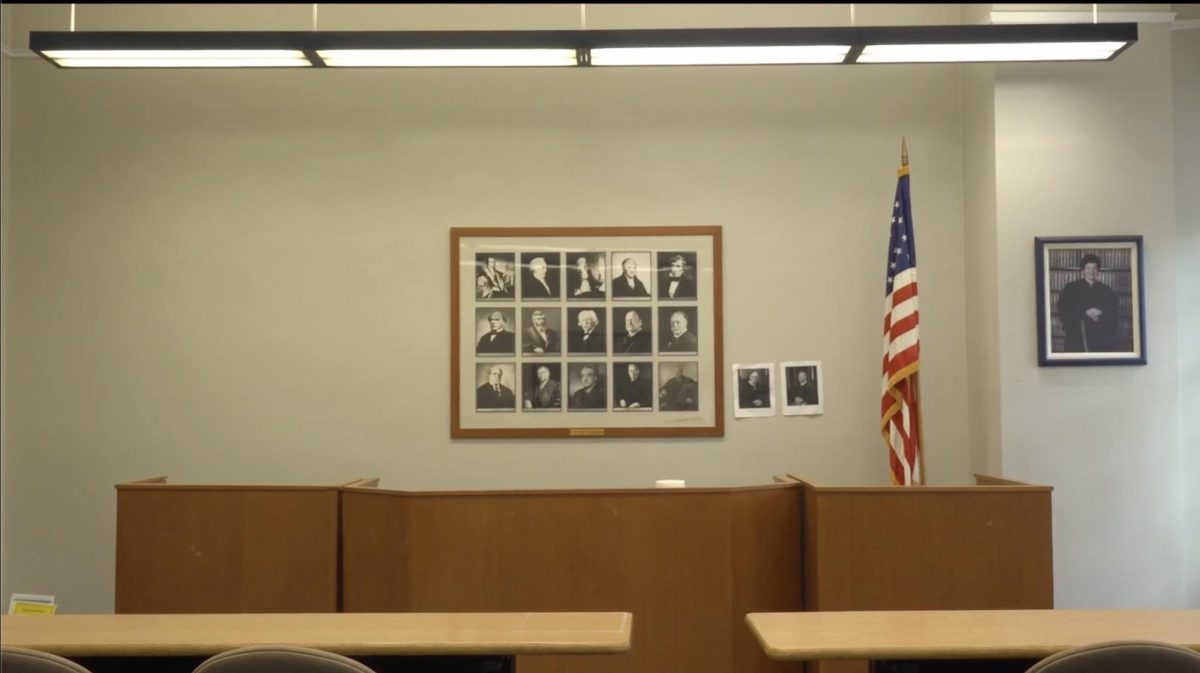
The debate took place in the Underwood Law Library on Monday, April 13. Speaker Daniel Gonzalez represented the Student Senate, while AHS was represented by its vice president, Byoung Lee. Lee also currently serves as the Student Senate treasurer.
Chief Justice Max Keating and Associate Justices Tessa Peterson, Margaret Turpel and Nick Cusson concurred on the decision. Associate Justice Arniv Vig, Lee’s roommate, recused himself from the case.
Lee gave the first opening statement as the petitioner’s representative. His primary argument rested on the claim that the Student Senate’s decision to strike AHS from the budget after putting it through the annual budget process and granting it a full charter contradicted governing bylaws.
“The evidence shows that senate itself kept AHS in the annual budget process, then approved AHS for a full charter, and only then moved to strike AHS from the budget on the basis of it being a non-charter,” Lee said.
The junior also argued that Student Senate did not follow prior precedent, citing a 2025 decision regarding the Performer’s Collective, a student-led organization of musical performers.
“The 111th Student Senate approved the annual budget on April 8, 2025,” Lee said. “Performers Collective was not approved for a full charter until April 15, 2025. Yet, the finance committee recommendation from that cycle still included Performers Collective.”
Subsequently, Gonzalez took the stand for his opening statement. Gonzalez argued that AHS’s status as a base charter at the time of submitting an annual budget request nullified their eligibility.
“A full charter status is a prerequisite to seeking an annual budget; it is not a guarantee to receive one,” Gonzalez said. “That prerequisite was not met at the time it matters. An ineligible request does not become eligible simply because the charter change is mid-process.”
Gonzalez added that even if AHS were eligible for an annual budget, Student Senate still would not have violated any bylaws.
“There is not a single governing document that prohibits chamber from amending a finance committee recommendation,” Gonzalez said. “No governing document requires that chamber accept every organization in said recommendation, and no governing document places any substantive condition of why that amendment may be offered.”
All justices then had the opportunity to question both Lee and Gonzalez about their opening claims. During Lee’s questioning, he stated that AHS did not communicate with the finance or organization chair of senate about its eligibility.
Lee’s responses fell heavily on the precedent set by Performers Collective, including after Associate Justice Turpel asked why AHS would apply for annual funding as a base charter, given Lee’s knowledge of the guidelines as treasurer of the Student Senate.
“I applied because, as previously stated, the Student Senate had the precedent where the Performers Collective was able to essentially apply for an annual budget,” Lee said.
In the final ruling, the court decided that the Performer’s Collective precedent did not supersede the governing documents of the Senate.
“Even accepting that description of prior practice, the Court is not persuaded,” the court said. “The meaning of the governing documents cannot be altered by a prior instance in which those documents may have been applied inconsistently.”
Gonzalez was questioned next, with early questions revolving primarily about whether he believed the Judicial Branch’s capacity to rule on procedural violations applied to the case.
“I don’t believe there is a question of procedural violation,” Gonzalez said. “The motion was properly made, was properly seconded, properly debated and the two-thirds majority was passed. Theoretically speaking… someone could make a motion to remove AHS because they don’t like the president. And if they convince two-thirds of the senate to do so, it’s their ability to do that.”
The justices then questioned why, if the bylaws state that a base charter can’t apply for an annual budget, senate allowed for AHS to move so far along in the process.
“[Finance committee was] unsure how to receive, and they said they’d rather let the chamber with said final authority make that decision,” Gonzalez said.
When Chief Justice Keating inquired why the finance committee didn’t bring it up to the Parliamentarian, the Senate executive responsible for interpreting the governing documents, before chamber, Gonzalez simply responded, “They absolutely should have.”
Senate Finance Chair Braden Freeman officially oversees the finance committee, but Lee, as treasurer, is expected to “prepare an annual budget with the cooperation of the Finance Committee Chair, Investments Committee Chair and members of the Cabinet,” according to the Student Senate Constitution.
Despite recognizing that the Finance Committee’s method could have been better, the court ruled that it did not act unconstitutionally and followed a proper course of action.
“Where an eligibility question is known or reasonably apparent, the better course is to disclose that question expressly so that the Chamber acts with full awareness of the issue before it,” the court stated. “It does conclude that clearer identification of the eligibility issue would have better served the orderly administration of the annual budget process.”
After closing statements, in which each side restated their cases a final time, Keating adjourned the meeting. After a seven-business-day deliberation period, the court issued its official opinion,with all four present justices ruling in favor of the respondent.
Alexander Hamilton Society will be eligible to apply for an annual budget during the next application cycle.