


President Donald Trump issued an executive order on Friday, April 3, that aims to regulate the transfer portal, student-athlete eligibility and revenue sharing for collegiate athletics.
The order, titled “Urgent National Action to Save College Sports,” comes amid a myriad of legal battles involving the NCAA. The most recent concern involved Ole Miss quarterback Trinidad Chambliss, who successfully filed for a sixth year of eligibility in March.
More notably, House v. NCAA was a landmark settlement made in July 2025 that ruled universities eligible to directly compensate student-athletes. As a result, your favorite student-athletes at SMU– Kevin Jennings or Boopie Miller, for instance– now receive payments directly from the university. The ruling even led to back payments being made to past student-athletes who missed out on NIL opportunities dating back to 2016.
So will the new executive order directly affect SMU and its student-athletes?
Not by a lot, at least without a federal law passed by the legislative branch to support it.
The American Constitution Society states that, “an executive order is a presidential statement directing how administration officials and agencies are to effectuate a duly passed federal law.”
Legislation has been created by both sides of the aisle to regulate collegiate athletics, but both have been stalled. Both the SCORE and SAFE Acts were introduced in 2025, but neither has passed through the House.
The SCORE Act, proposed by Republican lawmakers, has generally been deemed more institution-friendly, whereas the SAFE Act from Democrats is favorable to student-athletes. Without either act being voted into law, President Trump cannot force the NCAA, universities or student-athletes to abide by the rules listed in the executive order.
It is expected that lawsuits will arise challenging the constitutionality of the executive order shortly. Regardless, it was met with approbation from other notable figures in college athletics. ACC commissioner Jim Phillips, a supporter of the SCORE Act, released a statement on behalf of all ACC institutions praising the executive order.
“We deeply thank President Trump and his administration’s ongoing commitment to protecting college athletics by issuing today’s executive order,” Phillips stated. “Following the White House’s college sports roundtable, there continues to be significant momentum to preserve the athletic and academic opportunities for the next generation of student-athletes, and we appreciate the efforts.”
Furthermore, the president of the NCAA, Charlie Baker, said the executive order was an important step forward in stabilizing college sports.
“We appreciate the Administration’s interest and attention to these issues,” Baker said. “Stabilizing college athletics for student-athletes still requires a permanent, bipartisan federal legislative solution, so we look forward to continuing to work alongside the Administration and Congress to enact targeted legislation with the support of student-athlete leaders from all three divisions.”
If any sort of legislation were to be passed, President Trump’s order looks to create stricter enforcement on player eligibility and revenue-sharing.
In addition to a proposal to limit student-athlete eligibility to five seasons in a five-year window, the executive order limits the number of times a student-athlete can transfer schools. The order states that it will “provide for the ability to transfer one time during the five-year period with immediate playing eligibility, and one additional such time if the student-athlete obtains a four-year degree.”
Based on SMU’s rosters on April 4, 21 student-athletes are currently on at least their third team, the majority of whom play either football or men’s and women’s basketball. Based on the verbiage of the executive order, a player like SMU guard Jaron Pierre Jr. would have had to sit for an entire year after transferring to SMU– something that likely would have led to him staying at Jax State.
President Trump stated in the executive order that, because of the pressure to succeed in key sports like football and basketball, and thus be able to fund other sports, the rules on paying or adding transfer athletes have become too lax.
“College football is the primary revenue generator for university athletic departments, including revenue to support women’s and Olympic sports,” Trump wrote. “The same dynamic exists for basketball to a lesser degree.”
SMU has 17 division one teams, though the cross country and track & field teams have considerable roster overlap. 10 are women’s teams, many of which, including rowing and equestrian, fall under President Trump’s “Olympic” umbrella.
The order includes rules to increase funding to women’s and Olympic sports via revenue sharing, and prohibitions on “improper financial activities,” which include using federal funds for NIL and revenue sharing.
The Mustangs are no stranger to pay-to-play. The Death Penalty in 1987 was a result of illegal payments made to players, and since NIL’s legalization in 2021, SMU teams have improved dramatically: football made the College Football Playoffs, men’s soccer won an ACC Championship, volleyball posted its best season ever and men’s basketball made its first March Madness in 10 years.
SMU has been a definitive winner of the NIL era; it’s still not enough.
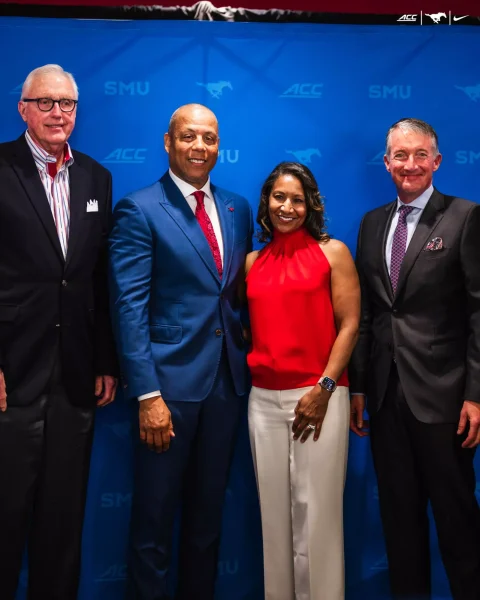
On Feb. 20, 2026, SMU launched the Boulevard Society, a fundraising group dedicated to recruiting and paying student-athletes, with a $50 million donation from a group of eight megadonors. Donors purchasing memberships to the society sign on for a five-year commitment ranging from $25,000 to $5 million a year. In the press release announcing the group, Athletic Director Damon Evans called the donation transformative to the university’s athletics program.
“Not only does it provide critical support for our amazing student-athletes, it also helps us launch our new giving society to inspire additional support from Mustang Nation,” Evans stated. “In the end, this gift is a foundational investment in SMU’s competitive excellence, the development of our student-athletes, and in our sustained success at the highest level of collegiate athletics.”
President Trump’s executive order claims the cost of trying to win in collegiate athletics is sending universities into debt, citing two universities, Penn State and Florida State, which ended the 2025 fiscal year with $535 million and $437 million in athletics-related debt, respectively.
In 2025, SMU Athletics reported that it broke even, with both revenue and expenses totalling at roughly $150.2 million. Men’s football was responsible for nearly one-third of all revenue and expenses, accounting for $45.3 million.
The executive order, should it gain legislative support, will go into effect on Aug. 1, 2026. If the men’s basketball transfer portal is any indicator, players and teams don’t seem too worried. Since opening on April 7, nearly 3,000 Division I players have entered the portal– more than half of all eligible players in the nation. Of SMU’s nine returning players, four are transferring.
Despite the best wishes of the NCAA and President Trump, slowing down the portal and the lucrative payments to players isn’t happening anytime soon. For now, SMU, along with every other school in the country, is going to put together the best teams their money can buy.